
- 業界
- Capital Markets
- ロケーション
- United States of America
- 使用した主な機能
- OneTick Cloud, OneTick Market Data
ポイント
- A global trading technology provider doubled the compute behind its TCA product, scaling from 16 to 32 vCPUs on dedicated cluster nodes.
- The firm extended its historical data window to four years and added consolidated EU equities coverage spanning up to 93,000 symbols.
- The TCA product runs on OneTick Cloud, using OneTick historical data, Point-in-Time and Interval queries, and 98.5% platform availability.
- Reconciling data entitlements and rationalizing symbol lists removed the operational overhead that came with the expansion.
- The result is double the compute and four times the historical depth, with capacity aligned to what the TCA product actually uses.
HOW A GLOBAL TRADING TECHNOLOGY PROVIDER SCALED THE DATA AND COMPUTE BEHIND ITS TCA PRODUCT WITHOUT ADDING OPERATIONAL COMPLEXITY
The Customer
The customer is a US-headquartered global provider of trading technology to banks, brokers, and asset managers worldwide. Its transaction cost analysis (TCA) product depends on deep, consistent historical market data and enough compute to analyze it quickly — and on both counts, its clients set the pace. The firm has been a OneTick partner for years, expanding its use of the platform as its own client base and data requirements have grown.
The Challenge
As demand for the firm’s TCA product grew, both the data and the compute behind it had to grow with it:
- Compute capacity had become the bottleneck, requiring an increase from 16 to 32 vCPUs on dedicated cluster nodes
- The TCA product needed a four-year historical lookback across its full symbol coverage, well beyond the existing entitlement
- Consolidated EU equities data was required alongside existing coverage, spanning roughly 18,000 to 93,000 symbols in total
- Managing static symbol lists for consolidated EU data was operationally heavy
- Data entitlements had accumulated across several successive schedules, and the symbol universes they covered needed to be reconciled
- Test and production environments had to be proven at the higher capacity before the switch
Why the Firm Chose KX
The firm chose to scale on KX because of:
- Headroom to scale both compute and history — vCPU capacity and a four-year data window — as the product grows
- Proven platform reliability, with 98.5% availability on OneTick Cloud
- Query capability suited to TCA workloads, including Point-in-Time and Interval queries and consolidated volume and VWAP
- Breadth of venue coverage, including LSE, TSX, Tokyo, and HKSE
- Commercial flexibility, with bundling across market data and trade surveillance making the total solution more cost-effective
- A collaborative approach to defining symbol limits and closing technical gaps
The Solution
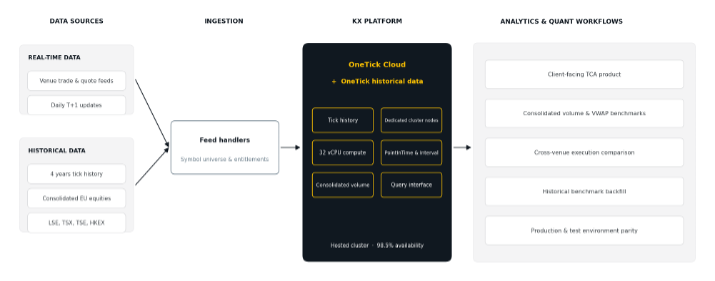
The firm runs its TCA product on OneTick Cloud, drawing on OneTick historical data and dedicated compute. The platform supports:
- Dedicated cluster nodes scaled to 32 vCPUs
- Four years of historical tick data across its symbol groups
- Consolidated EU equities data, alongside LSE, TSX, Tokyo, and HKSE databases
- Daily T+1 data updates alongside intraday and real-time queries
- Consolidated volume and VWAP calculations across venues
- Point-in-Time and Interval query support for point-in-time TCA
- Rationalized symbol lists, aligned to production need rather than legacy entitlement
Scaling was the easy half of the problem. The harder half was making sure the symbol universe the firm paid for matched the one its product actually used. Reconciling entitlements that had accumulated across several successive data schedules, then rationalizing the static symbol lists behind consolidated EU data, took the operational overhead out of the expansion. The higher capacity was validated in test, using two 16-vCPU nodes and a single 32-vCPU node. Production only moved onto it once that was proven, so the step up in compute arrived without a step up in risk.
The Outcome
The firm’s TCA product now runs on double the compute and four times the historical depth it had before, with consolidated EU equities coverage added alongside LSE, TSX, Tokyo, and HKSE. Symbol lists and compute allocation are aligned to what production actually needs, so the platform scales with the product rather than around it.
If your team is scaling into new markets or reconciling real-time and historical data across separate systems, see how OneTick Cloud handles it. Explore OneTick Cloud, or book a demo to talk through your setup.