

Key Takeaways
- Quantitative AI agents can support market investigation, strategy research, portfolio analysis, and post-event decision review when each agent has a defined task and controls.
- Temporal integrity preserves when events occurred and when information became available, helping firms avoid hindsight in backtests and explain AI-assisted decisions later.
- Combining market data with news, filings, research, and internal context on a shared timeline gives agents evidence that matches the market event they are analyzing.
- Production use requires controls over data access, models, prompts, tools, agent state, and human review, especially where sensitive capital-markets information is involved.
- Firms should require every quantitative AI workflow to show the data, tests, intermediate decisions, and point-in-time context behind its output.
The AI use cases that interest me most in capital markets are quantitative.
Research assistants already have a clear role. They can retrieve documents, summarize earnings calls, compare filings, and organize information. These capabilities save time. Capital markets also present a harder test: Can AI agents contribute to the analytical workflows where firms form, test, and review market decisions?
Can an agent examine a market move using price data, news, fundamentals, and internal research? Can a group of agents propose a trading hypothesis, write the code to test it, assess the result, and decide whether the idea needs another iteration? Can a firm reconstruct why the same system produced two different answers on two different days?
These questions have shaped much of our AI work at KX. The answers depend on far more than the language model. Quantitative agents need access to the right data, precise time context, clear responsibilities, repeatable evaluation, and controls that match the risks of the workflow.
That combination turns a convincing AI demonstration into a system that a trader, quant, risk manager, or technology team can examine and use.
How Do Quantitative AI Agents Work in Capital Markets?
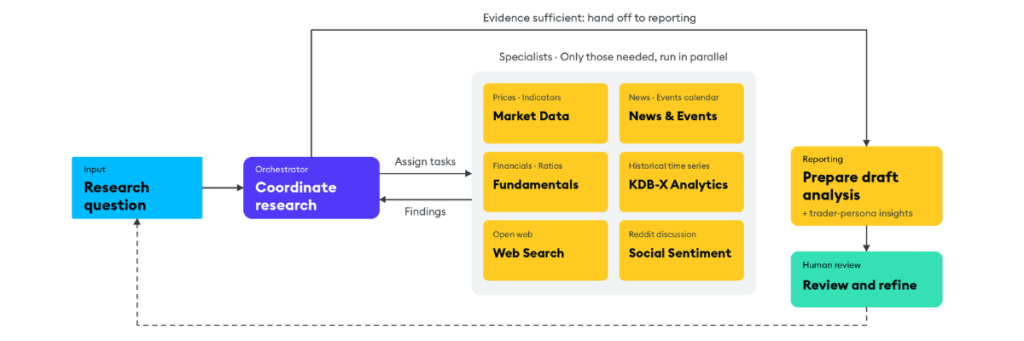
One practical design is to divide a quantitative workflow among specialized agents, with an orchestrator managing the sequence and handoffs. Not every step needs an agent: queries, calculations, and controls should remain deterministic where possible.
Consider a research question about a sharp move in a security. The orchestrator may begin with the firm’s internal market data. It might then call a news agent, retrieve relevant filings, calculate fundamentals, and send the combined findings to a reporting agent. Different trading or risk personas can assess the same evidence from their own perspective.
This structure makes the workflow easier to inspect. A team can see which sources the system used, what each agent returned, and how the final output developed. It also lets the firm apply different models and controls to different tasks. A model suited to document analysis or classification may be a poor choice for code generation.
The same principle applies to quantitative research. One agent can propose a hypothesis. A coding agent can translate the hypothesis into Python or q. An evaluation agent can run the test, calculate the chosen metrics, and send the result back for refinement.
I see this as a practical use of agentic AI. The system creates a draft version zero of the analysis. It gives a researcher something specific to inspect, challenge, and improve. Human judgment remains part of the workflow because the agent has no understanding of risk, market structure, or business context beyond the data and instructions it receives.
What Are the Main AI Agent Use Cases in Capital Markets?
Four emerging use cases are market-event investigation, trading-hypothesis testing, portfolio analysis, and cross-run explanation. Together, they show how firms can apply agentic AI to work that combines qualitative context with quantitative evidence across research, trading, risk, and compliance.
Investigate Market Events
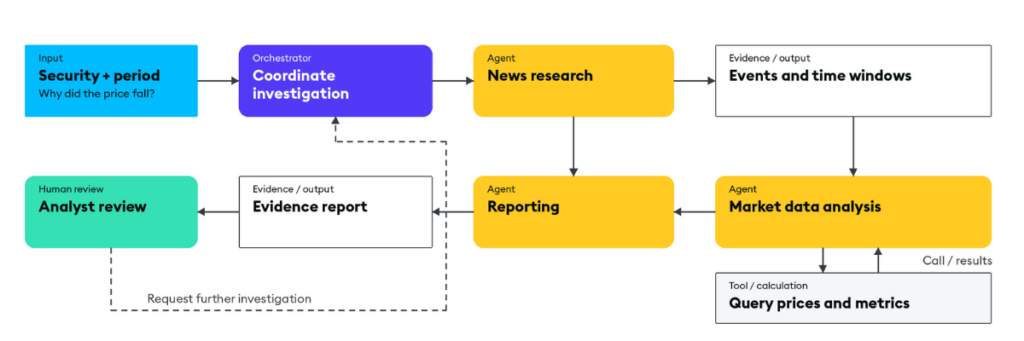
AI agents can investigate market events by examining price and volume data alongside news, earnings calls, filings, analyst research, and desk commentary. A market event rarely has one clean explanation, but an agentic workflow can query these sources together and examine the relationships between them.
For example, a user might ask why a security fell during a particular period and instruct the system to use internal data where available. The orchestrator can decide which agents and sources it needs, retrieve the evidence, and build a report.
The value comes from the combination of sources and the sequence in which the system examines them. The agent may identify an event in a news database, establish the relevant time window, and then query market data for that period. It can repeat the process across several events and compare the resulting market behavior.
The system can assemble evidence associated with the move, but it should distinguish contemporaneous events from proof of causation.
This type of investigation can reduce the manual work involved in moving between databases and applications. It can also preserve the path from the original question to the evidence used in the answer.
Generate and Test Trading Hypotheses
AI agents can support each stage of trading-hypothesis research, from idea generation and implementation to testing and revision.
A hypothesis agent might begin with an instrument, time horizon, and broad strategy such as momentum or mean reversion. It can propose entry logic, exit logic, position sizing, filters, and risk conditions. A coding agent can turn the proposal into testable code. An evaluation agent can run a backtest and review metrics such as the Sharpe ratio, drawdown, turnover, and sensitivity to transaction costs.
The result may show that the hypothesis needs work. The evaluation agent can send a specific instruction back to the hypothesis or coding agent, which starts another iteration. The research team receives the proposed logic, the code, the results, and the history of revisions.
This workflow can help a team examine more ideas and reject weak ones earlier. It still needs the same discipline as any other quantitative research process. The firm must prevent lookahead and survivorship bias, use point-in-time data, account for realistic trading costs, and validate results outside the period used to develop the strategy.
Greater testing capacity creates a further risk: the more hypotheses the system examines, the more likely it is to find an apparently successful result by chance. Evaluation criteria and controls for repeated experimentation need to be defined before the team treats an output as useful.
The agent contributes speed and breadth to the research process. The quant decides whether the hypothesis makes economic sense.
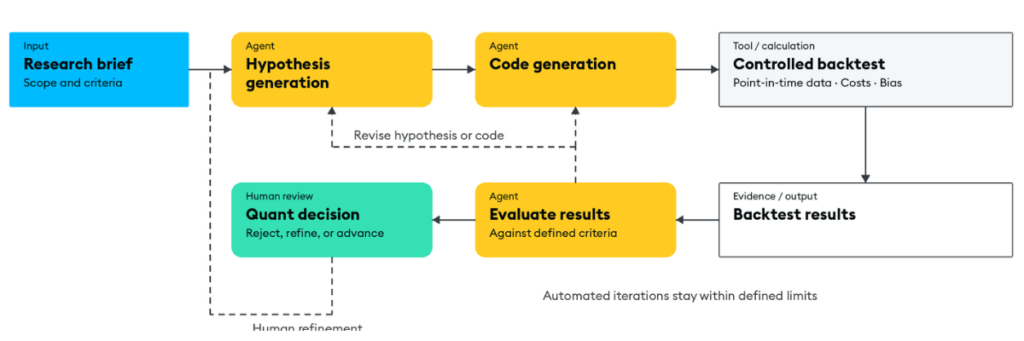
Here is an example of an ‘Alpha Agent’. It supports systematic strategy development—from hypothesis generation and executable code creation through GPU-accelerated backtesting. Results are assessed for code quality, performance, and supporting evidence, with walk-forward analysis and anti-overfitting checks guiding further refinement and human review before controlled deployment.
Support Portfolio Analysis
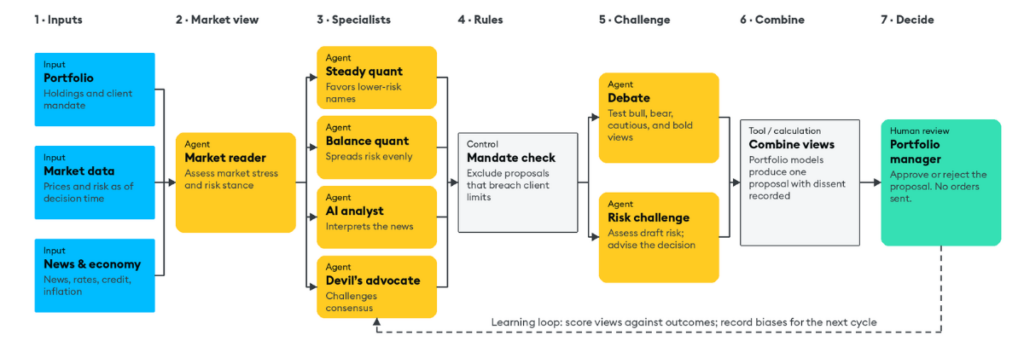
AI agents can support portfolio analysis by adding information from news, research, macroeconomic data, and other unstructured sources to established allocation and rebalancing methods.
Several agents might generate allocation proposals using different methods or assumptions. Those proposals can be passed through established portfolio and risk models before an agent compares the reasoning and trade-offs. A separate agent can challenge a proposal from a risk perspective, but it does not replace independent risk controls. The portfolio manager retains control of the final decision.
Point-in-time testing is essential in this workflow. To evaluate a monthly rebalancing process retrospectively, the system must use only the data and news available at each historical rebalance date. Current information cannot enter an earlier decision. If it does, the backtest measures hindsight.
That requirement makes portfolio analysis a Temporal AI problem. The quality of the output depends on whether the system can reconstruct the information available at each decision point.
How Can Firms Explain Why an AI Decision Changed?
Agentic systems can produce different outputs as data, prompts, models, tools, and policies change. Generative models may also vary their output even when the visible inputs appear unchanged. Firms need a precise way to compare those runs.
Take a simple hypothetical example. A user asks whether to buy a particular stock. The system analyzes the company and produces a recommendation. The user runs the same question the next day and receives a different answer.
Many things could have changed. New market data may have arrived. A news article may have altered the context. The model or system prompt may have changed. An agent may have called a different tool. A configuration error may even have caused part of the workflow to analyze the wrong company.
A cross-run comparison can examine the source data, model and sampling configuration, prompt, code and tool versions, agent state, intermediate outputs, and final response. It can identify where the runs diverged and help investigators understand how that divergence affected later steps.
This is more useful than a log of the final answer. The firm gains a record of what information the system accessed, what it did, and what appears to have influenced the changed outcome. Risk and compliance teams can use the same record to reconstruct an AI-assisted decision after the event.
Why Does Time Context Matter for AI in Capital Markets?
Every quantitative use case above depends on time.
Market data, news, filings, research, and internal communications arrive on different schedules. Some information arrives late or out of order. Some records are corrected. Models and prompts change. Permissions and policies can also change between one run and the next.
An agent needs to understand more than the latest state of each source. It needs a record of the state that applied when the decision was made.
This is the role of temporal integrity. At a minimum, the system preserves when an event occurred and when the information became available to the firm. Those times can differ. Maintaining both allows the firm to ask a precise question: What information was available to this workflow at this point?
The distinction affects research quality. A backtest that uses a later correction, revised economic figure, or subsequently published news item can appear more successful than the strategy would have been in practice. The model has seen information that the historical decision maker could not have known.
Temporal integrity also affects governance. If a firm reviews an AI-assisted decision several months later, the current system may bear little resemblance to the system that made the original recommendation. The source data may have changed. The firm may have introduced a new model, prompt, threshold, or approval policy. A defensible reconstruction needs the state of each relevant component at the time of the decision.
Our work on KX Temporal AI focuses on bringing this point-in-time discipline to AI workflows: connecting agents to time-aware data and preserving the context needed to test, compare, and investigate their actions.
How Do AI Agents Combine Structured and Unstructured Market Data?
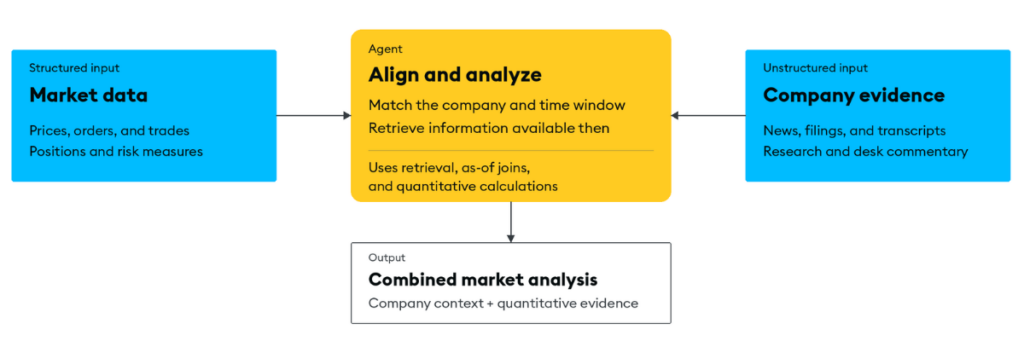
AI agents can combine structured and unstructured market data by placing both on a shared timeline. Prices, orders, trades, positions, and risk measures sit alongside news, filings, earnings-call transcripts, analyst reports, and desk communications.
An agent may begin with an unstructured event and then examine its quantitative effect. For example, it can identify when a company discussed a change in demand, find the corresponding window in the market data, and analyze price, volume, volatility, and order-book behavior around that period.
Temporal joins make this possible. An as-of join matches each record with the most recent relevant information that was available at that time. Using the information-availability time matters: joining against a later correction can still introduce hindsight. The system can apply the same method across many events and large market datasets.
Keeping structured and unstructured data close to the same analytical workflow also reduces the amount of movement between separate systems. The agent spends less time passing queries and results between a vector database, market database, document store, and application layer. The architecture becomes easier to operate and inspect when the data and analytics share a consistent treatment of time.
The result is a stronger form of retrieval-augmented generation (RAG). Retrieval provides context that matches the event, time window, and information state under examination. The language model then works from evidence tied to market reality.
What Controls Do Production AI Agents Need in Capital Markets?
Production AI agents need controls over data access, model deployment, workflow behavior, and operating costs. These controls matter because positions, order books, client activity, internal research, and desk communications can all be sensitive.
Firms therefore need choices about where the system runs. Depending on the use case and the firm’s policies, the workflow may use managed model endpoints, models deployed in a private cloud environment, or models running on-premises. The data, retrieval layer, agent state, and model inference process must follow the firm’s security and access controls.
Local or privately deployed models introduce engineering questions of their own. Teams need to consider model size, quantization, GPU capacity, isolation between users, throughput, and monitoring. They also need to decide which model fits each task.
A large frontier model may be appropriate for complex reasoning. A smaller, specialized model may handle financial news classification at lower cost. A router can direct each request to the model that fits the task. For repeated questions, a governed cache can reuse an earlier result when the underlying data, user permissions, and time context still match.
These choices affect the economics of the system. A retrieval query that takes a fraction of a second may sound like a minor technical improvement when the model takes longer to generate its response. At institutional scale, retrieval speed helps determine how many concurrent questions the system can support and how much infrastructure it needs.
This is why I use a simple principle when discussing sovereign AI: Own the model, own the data, own the economics. Ownership in this context means control. The firm decides where its data goes, which models process it, how the workflow is governed, and how costs change as use expands.
What Evidence Should Firms Require From Quantitative AI Agents?
Firms should require quantitative AI agents to show the evidence, tests, intermediate decisions, and point-in-time context behind an output. Access to capable models will continue to widen; the differentiating work lies in the system around the model and the institutional knowledge made available to it.
For quantitative agents, that system needs an evidence standard. Each workflow should make it possible to answer a set of practical questions:
- Which data did the agent use?
- What information was available at that time?
- Which model, prompt, and tools produced the result?
- Did the test exclude information published later?
- How was the result validated, and against which criteria?
- What changed between two runs?
- Where did human review enter the process?
These questions give development, trading, risk, and compliance teams a shared way to assess an agentic workflow. They also expose weaknesses early. If the team cannot reconstruct the information state behind an output, it knows where to focus its engineering work.
The most useful capital-markets agents will generate more than an answer. They will provide the hypothesis, evidence, test, intermediate decisions, and point-in-time context needed to assess that answer.
That is the standard we should set for quantitative AI: a system that can contribute to the work and show its work.
See how KX’s Temporal AI Infrastructure can help firms connect quantitative AI agents to time-aware data and preserve the point-in-time context behind trusted, defensible decisions.
Explore the KX and NVIDIA AI blueprints and samples to see how you can bring market data, news, filings, and other sources together in AI-assisted research workflows.