Capital markets demand Temporal AI
In capital markets, time isn’t just another data point. It’s central to the meaning of data.
That’s why capital markets AI needs more than relevant information. It needs Temporal Intelligence to understand how market conditions evolve, how events are sequenced, and what was knowable at each point in time. AI systems must understand when, not just what.
KX is the Temporal AI Infrastructure for capital markets. It provides the Temporal Integrity that models and agents depend on, preserving what was true, when it was true, and what was known at each decision point. The result is correctly sequenced, context-rich, and traceable market data that supports timely, informed decisions.
Why Temporal Intelligence matters in capital markets
Every AI decision depends on a specific market state, spanning prices, orders, trades, positions, reference data, risk signals, news, research, and other information available at the time.
But market conditions change continuously. Without temporal context, even technically accurate information can produce misleading results. Backtests may incorporate future knowledge, retrieval systems can surface outdated information, and agents might act on a distorted view of the market.
Such mistimed AI outputs distort risk, obscure signals, increase regulatory exposure, and make decisions harder to defend. This exposes firms to significant financial, regulatory, and reputational damage.
Even the right information can mislead AI if it’s from the wrong moment. We call this temporal hallucination. Discover the risks of temporal hallucination.
Temporal Intelligence vs Temporal Integrity
What is Temporal Intelligence?
Temporal Intelligence enables systems to understand event sequences, changing market states, and relevant history while accounting for information freshness, duration, and decay.
By recognizing temporal patterns and evaluating information within the correct decision window, AI can drive more informed analysis and action.
What is Temporal Integrity?
Temporal Integrity is the preservation of the timing, sequence, and context of data required for reliable Temporal Intelligence.
It records when events occurred, when information became known to a system, and how market states changed. It also retains subsequent corrections, revisions, and data provenance, enabling accurate point-in-time reconstruction.
Temporal Intelligence describes what a system can understand. Temporal Integrity provides the data foundation that makes that understanding operational.
KX unlocks Temporal Intelligence in capital markets AI by providing the Temporal Integrity it depends on. By capturing, organizing, analyzing, and serving market data through time, KX gives models and agents access to relevant real-time and historical context. This enables firms to ground AI analysis and decisions in the appropriate market state, with the ability to reconstruct the supporting information afterwards.
Explore why temporal context matters for capital markets AI
Time changes the meaning of market data
A timestamp alone can’t establish the full context behind a market event. For AI to interpret market data correctly, it needs to preserve event sequences, distinguish when information became available, and align different sources with the appropriate point in time.
Consider a trade executed when the order book shows bids for 100,000 shares. Milliseconds later, 50,000 are canceled. Using the later order book would misrepresent liquidity at execution. Similarly, imagine earnings available at 9 a.m. are corrected at 11 a.m. AI analyzing a 10 a.m. trade must use the original filing, not the subsequent correction.
Temporal Integrity from data to decision
KX preserves Temporal Integrity as market and enterprise data moves through the AI lifecycle. From ingestion and analysis to AI-generated outputs, the objective is to maintain the timing, sequence, and context needed to support decisions and reconstruct the information behind them.
Stage 1: Capture and prepare
Prepare consistent, AI-ready market and enterprise data.
- Streaming and historical data
- Ingestion, normalization, and enrichment
- Symbology, corporate actions, and data quality
Stage 2: Organize through time
Preserve the timing, sequence, and changing state of information.
- Event sequencing and bi-temporal integrity
- Version management and point-in-time views
- Temporal joins and contextual alignment
- Historical state reconstruction
Stage 3: Compute and retrieve
Deliver relevant analysis and context within the decision window.
- Real-time and historical analytics
- High-performance temporal queries and feature calculation
- Vector search, semantic retrieval, and Temporal RAG
Stage 4: Apply and reconstruct
Support AI decisions and trace their underlying information.
- Models, LLMs, and agents
- Research, trading, risk, and surveillance
- Decision replay, provenance, and audit
- Human review and control
Trace and replay supporting data
Where temporal gaps appear in AI workflows
Failing to ensure Temporal Integrity at the capital markets data layer makes AI outputs difficult to trust or validate.
Look-ahead bias
Historical data may contain information unavailable at the original decision point. Research and backtests can then produce results that can’t be recreated under live conditions. Look-ahead bias often starts in the data layer, through adjusted prices, restated fields, or corporate actions applied with the wrong effective date.
A backtest uses historical prices adjusted for corporate actions that had not yet occurred, overstating a strategy’s performance.
Stale or superseded context
AI retrieval systems may find relevant filings, research, signals, or market events without recognizing that subsequent developments have changed their meaning.
An AI trading agent uses a risk signal from an earlier market regime, overlooking more recent conditions that invalidate it.
Incomplete reconstruction
Teams may retain AI outputs without preserving the exact data, model version, and context available when they were generated. Reconstructing the information behind a decision becomes difficult. Over time, missing evidence compounds into AI audit debt.
A surveillance team can’t reproduce the market state and supporting information behind an AI-generated trading alert.
Fragmented timelines
If structured market data and unstructured news, research, and other information reside in separate systems and timelines, it’s harder for models and agents to reason reliably across them.
An agent investigating a price movement links it with news that was published before the event but only became available to its system afterwards.
The business and operational impact on capital markets firms
Temporal gaps affect more than data quality. They increase the cost per correct decision: the total effort required to reach a decision that can be validated, trusted, and acted on.
That cost appears in multiple places. A wrong or late decision can lose value. Model validation and approval can take longer. Risk, compliance, and surveillance teams may spend more time reconstructing the context behind an output. And successful AI pilots can remain stuck outside production if their supporting data can’t be reproduced or defended.
Stronger Temporal Integrity can change that equation. By improving research-to-production fidelity, preserving the evidence behind decisions, and making historical market states easier to reconstruct, firms can:
- Reduce validation and investigation effort,
- Move viable AI workflows into production faster,
- Act on time-sensitive opportunities with greater confidence.
See how Temporal Integrity supports trusted AI
Building the data foundation for Temporal AI
Temporal Intelligence can’t be added after the fact. The underlying data architecture must preserve timing, sequence, state, and context from the point of capture, before information reaches models or agents.
Six architectural capabilities provide that foundation.
Preserve sequence and state
Capture and timestamp incoming events, preserving their original sequence and the market state before and after meaningful changes. Event histories and state management enable systems to reconstruct order books, market conditions, and signals rather than relying on isolated snapshots.
Maintain bi-temporal integrity
Preserve both event time and knowledge time, including late arrivals, corrections, and subsequent revisions. Versioned records allow systems to query what was true and what was known at any historical decision point without introducing future information.
Unify real-time and historical data
Connect streaming and historical data in one analytical environment. As-of joins, window functions, and temporal queries enable teams to apply the same analytical logic across historical research, backtesting, and live markets, reducing research-to-production inconsistencies.
Align data with context
Use temporal joins to connect structured market events with relevant news, filings, research, and proprietary information. Combine semantic search with temporal filtering through Temporal RAG, retrieving information based on both its relevance and its validity within the decision window.
Retain provenance and versions
Preserve original sources, historical identifiers, symbology changes, corporate actions, corrections and data lineage. Maintain effective dates and version histories so systems can distinguish original records from subsequent adjustments and trace analytical results to their underlying data.
Reconstruct at production scale
Support point-in-time queries, historical reconstruction and continuous high-volume processing without compromising production latency. Efficient temporal computation, including GPU acceleration where appropriate, enables demanding analytical workloads.
AI models are probabilistic. The data and historical market states supporting their decisions must be queryable, reproducible, and verifiable.
Where KX fits in the capital markets AI stack
KX provides the Temporal AI Infrastructure between capital markets data sources and the models, applications, and agents that use them.
It’s the missing layer that brings market data, temporal computation, and AI retrieval together, grounding downstream intelligence in the market state relevant to each decision.
Time-aware data foundation
KX prepares and organizes high-volume market data, preserving event sequences, timestamps, and historical context. OneTick Market Data supports multi-venue normalization, historical symbology, and corporate-action adjustments, while bi-temporal data management preserves when information was valid and when it became known.
Unified temporal data and compute
KX brings streaming, historical, and vector analytics into a common environment. Native temporal joins and window functions support point-in-time analysis, while shared analytical logic reduces inconsistencies between research and production. KDB-X can also leverage GPU acceleration for demanding operations, including large joins and aggregations.
Models and agents grounded in market context
KX combines temporal analytics with semantic and vector retrieval. Through Temporal RAG, AI can retrieve information according to both semantic relevance and temporal validity, connecting market events with the information available during the decision window. Query interfaces and MCP connectivity give applications and agents access to temporal data and analytics in existing workflows.
Replay and temporal audit
KX supports historical market-state reconstruction through time-aware queries, retained data history and provenance. These capabilities support research validation, trade reconstruction, surveillance, and investigation, providing the historical context and supporting evidence needed to review AI-assisted decisions.
Built to work with your existing AI architecture
KX complements existing enterprise data platforms, models, and applications rather than requiring firms to replace them. Support for open data formats and established development environments allows organizations to introduce specialist temporal processing alongside their wider data and AI infrastructure.
As model capabilities become more widely available, differentiated intelligence increasingly depends on the proprietary data beneath them and on preserving the sequence, timing, state, and context that give that data meaning. Data is the Algorithm.
Examine the technology behind KX’s Temporal AI Infrastructure
What Temporal Integrity enables
Temporal Integrity supports AI across the capital markets lifecycle, from quantitative research and real-time decision-making to surveillance and post-event review.
By preserving the timing, sequence and historical context of information, firms can develop more reliable AI workflows and reconstruct the data behind their outputs.
Quantitative research and backtesting
Reconstruct the information available at each stage of a strategy, excluding future knowledge from historical evaluation. Test strategies against point-in-time market conditions to improve consistency between research assumptions and live production.
AI-assisted research and Temporal RAG
Investigate market movements using relevant news, filings, transcripts, research, and proprietary information. Temporal RAG combines semantic relevance with temporal validity, helping researchers understand events using the information available at the time, rather than subsequent developments.
Trading and investment agents
Give agents access to sequenced live and historical market data, including the information relevant to each decision window. This supports timely signal evaluation, market analysis, and trading decisions based on traceable inputs and appropriate controls.
Risk, surveillance, and decision review
Reconstruct the market conditions, event sequences and supporting information behind alerts, recommendations and automated actions. Enable more efficient investigations, model validation, and regulatory review.
Client and market intelligence
Connect client activity, positions, and trading history with the market conditions and internal information available at each point in time. Understand client needs and rapidly identify relevant opportunities for more informed engagement.
AI-ready data operations
Prepare and serve market data while preserving its timestamps, historical versions, and provenance. Maintain consistent temporal context across research and production, reducing duplicated data preparation and supporting reliable downstream AI workflows.
Assess your AI’s temporal readiness
Use these six questions to assess whether your current data architecture provides the temporal integrity AI workflows require.
Start with one important AI-assisted decision. It could be a trading recommendation, a research result, a surveillance alert or an existing AI pilot.
-
Reconstruct the evidence
Can you establish exactly what information was available when the decision was made?
Consider: Original sources, historical versions, and information availability.
-
Verify bi-temporal integrity
Does your architecture preserve when events occurred and when information became known?
Consider: Event timestamps, ingestion times, and subsequent revisions.
-
Account for changing information
Can you identify information that arrived late, was corrected, or was subsequently superseded?
Consider: Historical data corrections and changes to reference information.
-
Align market data and context
Can you establish which structured and unstructured information was available during the same decision window?
Consider: Market events, news, filings, research, and their respective availability times.
-
Replay the supporting data
Can you reproduce the historical data state used to generate the original output or action?
Consider: Point-in-time queries, data versions, and derived analytical inputs.
-
Validate production readiness
Can you maintain the same temporal integrity at production data volumes and within the required latency?
Consider: Peak message rates, continuous ingestion, and time-sensitive retrieval.
Any question you can’t confidently answer signals a potential gap.
Discuss your findings with a KX expert
Build sovereign AI on temporal market data
Your proprietary data, signals, market history, research, and institutional expertise provide the foundation for differentiated AI.
But that information must retain its temporal context. Without the ability to connect proprietary intelligence to the market conditions in which it was created, firms risk losing much of its value.
Sovereign AI brings these capabilities together with organizational control over how intelligence is developed, deployed, and used.
KX and NVIDIA provide adaptable reference architectures that combine KX’s time-aware data foundation with NVIDIA’s accelerated compute and AI infrastructure. These support the development of proprietary intelligence across research, trading, and alpha workflows.
What sovereign AI means in practice
Proprietary data
Retain control over the market, enterprise, alternative, and research data that grounds your AI, including how it is accessed, processed, and used.
Flexible deployment
Choose where AI infrastructure and workloads operate, according to your performance, security, regulatory, and operational requirements.
Adaptable models
Select, customize, and evaluate models according to your requirements, rather than depending on a single model or provider.
Tailored agent behavior
Define how agents access information, invoke tools, interact with other systems, and operate within organizational policies and controls.
Institutional knowledge
Preserve and apply proprietary research, historical intelligence, analytical methods, and expertise within your AI workflows.
Intellectual property
Maintain control over the proprietary signals, models, analytical processes, and resulting intelligence developed from these assets.
Adapt the architecture to your organization
KX and NVIDIA blueprints provide practical starting points rather than requiring a single operating model.
Firms can adapt them to their own data, models, infrastructure, policies, and decision processes, with deployment options spanning on-premises, private, hybrid, and cloud environments. This allows organizations to develop AI around their proprietary intelligence while retaining control over the wider architecture.
Explore the KX and NVIDIA blueprints
The KX and NVIDIA sovereign AI signal factory
KX and NVIDIA combine time-aware market data with GPU-accelerated AI infrastructure to provide adaptable, end-to-end sovereign AI architectures for capital markets.
KX unifies streaming time-series and multimodal data in a single high-performance platform. NVIDIA’s AI software stack optimizes retrieval, embedding, model orchestration, and inference.
This enable firms to build and deploy scalable, traceable agentic AI workflows while retaining control over proprietary intelligence within their chosen operating environment.
Four technology layers, bottom to top:
- NVIDIA accelerated computing: GPU-powered infrastructure.
- KX temporal data foundation: AI-ready market data, normalization, temporal alignment, point-in-time analytics, vector retrieval and replay.
- Models and frameworks: Reasoning, retrieval, orchestration, evaluation and distillation.
- Capital markets agents: AI Research Assistant | AI Trader Agent | AI Alpha Agent.
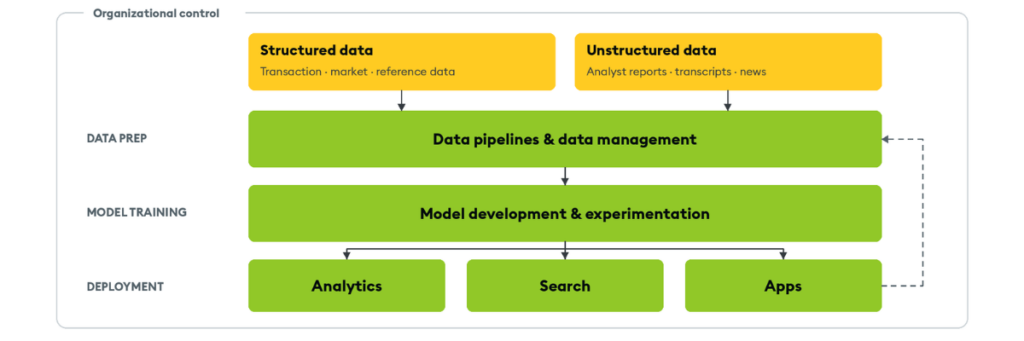
Diagram annotations:
- Input: Proprietary data, market history, signals, research and IP.
- KX: Temporal integrity, analytics and retrieval.
- NVIDIA: Accelerated computing and AI frameworks.
- Return arrow: Historical data replay and validation.
- Deployment: On-premises, private, hybrid or cloud.
- Outer boundary: Organizational control over data, models, agents and deployment.
Move from fragmented data to continuous intelligence
Three agents built with KX and NVIDIA
The KX and NVIDIA blueprints demonstrate how a shared Temporal AI foundation can support three distinct capital markets workflows: deep research, real-time trading intelligence, and systematic strategy development. Each combines AI capabilities with time-aware market data, traceable evidence, and human oversight.
Discover why agentic AI needs temporal intelligence
AI Research Assistant
Powered by: NVIDIA RAG Blueprint
Automates deep research, from planning and query generation to parallel retrieval across market data, enterprise documents, and approved external sources.
It processes text, tables, and charts, identifies research gaps through iterative reflection, and produces structured, citation-backed reports for human review and refinement.
Temporal requirement: Align documentary evidence and market activity with the relevant decision period, grounding research in the information available at the time.
AI Trader Agent
Powered by: NVIDIA AIQ Blueprint
Helps traders investigate market movements using natural-language queries. A central orchestrator coordinates specialized agents analyzing market data, news, fundamentals, social information, web sources, and internal analytics in parallel. Findings are cross-checked and synthesized into confidence-scored insights with risk context and supporting evidence.
Temporal requirement: Align findings to the same market window using streaming data and point-in-time analytics, with replay supporting subsequent investigation.
AI Alpha Agent
Powered by: AIQ and Data Flywheel/Distiller Blueprints
Supports systematic strategy development, from hypothesis generation and executable code creation to GPU-accelerated backtesting. Results undergo evaluation against code quality, performance metrics, and supporting evidence, with walk-forward and anti-overfitting checks informing subsequent refinement and human review before controlled deployment.
Temporal requirement: Use point-in-time historical data and replay to prevent future knowledge from contaminating strategy evaluation.
Learn more about these production-grade agents
RBC Capital Markets applies AI to research at scale
RBC Capital Markets worked with KX and NVIDIA on a proof of concept to augment analyst research with generative AI.
Combining KX’s time-series and vector analytics with NVIDIA accelerated computing, the solution brought together structured market data, alternative data and unstructured information. Analysts could ask natural-language questions and receive clearly sourced answers grounded in millions of data points.
The proof of concept directly informed Aiden QuickTakes, a production capability incorporating specialized agents for earnings analysis and filings research. It helps reduce research workflows from hours to minutes while retaining human oversight.
RBC Capital Markets is now extending this successful collaboration into additional sales and trading applications.
Read the RBC Capital Markets story
Decades of data expertise in capital markets
Temporal AI introduces new demands, but its essential foundations lie in the same data challenges KX has spent decades solving for leading capital markets firms.
30+ years in capital markets
KX technology has supported demanding trading, quantitative research, risk, surveillance, and market-data workloads for more than three decades.
Engineered for market time
Combining real-time, historical, structured, and unstructured data, KX was designed for the scale, latency, and data structures used across global markets.
Trusted globally
KX is used by 8/10 top global investment banks. Financial institutions collectively managing more than $50 trillion rely on its infrastructure.
Assess the temporal integrity of your AI workflows
Let us help you identify where temporal gaps could limit your AI workflow in production.
Bring KX an AI use case, existing pilot, agentic workflow, or production challenge. Our experts can examine the decision or workflow you want to enable, the structured and unstructured data it depends on, and how timing, sequence, and changing market state are represented. We can also assess requirements for provenance, replay, and production performance, alongside your deployment, model and data-control priorities.
Together, we can identify where temporal context or historical reconstruction may break down, determine where KX could strengthen your existing architecture, and define a practical path forward.