Trust in an AI-assisted decision depends on the data context behind it. In capital markets, teams need to know when an event happened, when their systems received the information, and what data was available when the decision was made.
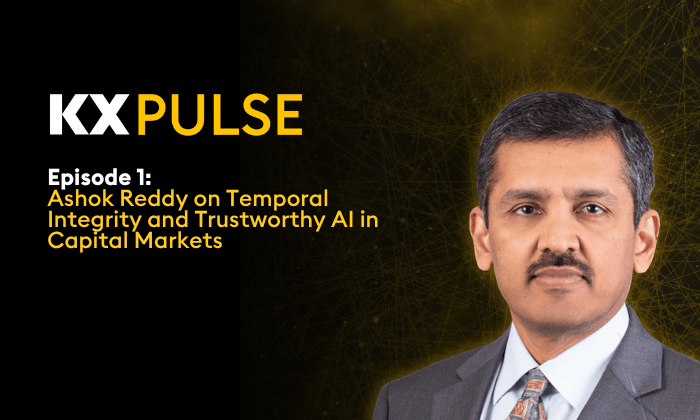
In this episode of KX Pulse, KX Chief Executive Officer Ashok Reddy discusses how temporal integrity helps financial institutions preserve this point-in-time context across AI, trading, research, and analytics workflows.
The Two Clocks Behind Every AI Decision
In capital markets, every event has two clocks.
The first is the shared market clock: when a trade happened, a price changed, or information was published.
The second is the knowledge clock: when that information reached your system and became available to use.
Those clocks do not always move together. Data can arrive late, appear out of sequence, or be revised after the event. That difference matters when AI systems use historical data to make predictions, test strategies, or support decisions.
Temporal integrity preserves both clocks. It allows teams to reconstruct what happened in the market and what the system actually knew at a specific point in time.
That distinction helps teams test AI against the information available at the time, identify lookahead bias, and review decisions with the correct historical context.
Why Lookahead Bias Matters for AI
Historical data can contain information that was unavailable when a decision would have been made.
A revised economic figure, a corrected market record, or a later event can become part of the dataset used for backtesting. If the system treats that information as though it was already known, the test no longer reflects the conditions the model would have faced in production.
Ashok describes this as a familiar problem for quantitative teams: lookahead bias.
A model can appear to predict an outcome accurately because the historical data already contains information about what happened next.
Preserving the knowledge clock gives teams a way to test against the data that was available at the time, rather than the more complete record available today.
Reconstructing What the System Knew
For Ashok, trust also depends on the ability to replay a decision.
Teams need to be able to return to a specific point in time and reconstruct the information available to the system. That includes the data it had received, the order in which information arrived, and the state of the system when the decision was made.
This becomes important when firms need to investigate an AI-assisted decision, assess model behavior, or understand why a result differed from expectations.
A useful test is simple: can the team reproduce what the system knew at that moment?
If the answer requires rebuilding the decision from incomplete records, the temporal context has already been lost.
Ground Truth for Probabilistic Models
AI and machine learning are probabilistic. Human judgment remains part of how firms interpret and act on their outputs.
Ashok argues that capital markets have an important source of ground truth: the market itself.
Trades happened. Prices moved. Orders were placed. Those outcomes provide an observable record against which models and signals can be assessed.
This becomes especially useful when firms combine structured and unstructured data.
An earnings call, for example, may produce positive sentiment. Market data can show whether that sentiment translated into buying activity, whether the move had already been priced in, or whether order-book behavior told a different story.
Bringing those data types together gives teams more context for assessing an AI-generated signal against what occurred in the market.
Building Intelligence From Your Own Data
Ashok also points to proprietary data and institutional knowledge as important parts of an AI strategy.
Financial institutions can combine external models with their own market data, business data, research, and experience. The aim is to give AI systems access to information and context that reflect how the firm operates and makes decisions.
That requires data to be prepared for AI use. Timing, sequence, metadata, and historical context all matter.
Ashok also describes a model strategy in which firms select different models for different tasks rather than using the same model for every workload. The model is one component of the system. The data and context around it determine what the system can know and how its output can be assessed.
How KX Supports Temporal Integrity
Temporal integrity starts with the data. AI systems need accurate market history,
consistent timestamps, and enough context to establish what was knowable at a given
point in time. They also need an analytics engine that can work across real-time and
historical data as events unfold.
KX brings these requirements together through OneTick Market Data and KDB-X.
An AI-Ready Market Data Foundation With OneTick Market Data
OneTick Market Data provides curated, normalized tick and reference data across global
markets. Data is collected, mapped, adjusted, validated, and prepared for analysis
before it reaches research, backtesting, or AI workflows.
This foundation includes:
- Point-in-time market data for research and backtesting
- High-resolution exchange timestamps and event sequencing
- Historical symbology and cross-reference mapping
- Corporate actions and adjustment factors applied consistently over time
- Normalized schemas across markets and asset classes
- Historical market data for replay and reconstruction
For AI workflows, these controls matter because the quality of an output depends on
the data the system can access. Preserving point-in-time market context helps teams
reduce lookahead bias and assess a model or agent against information that was
available at the time.
A Temporal Analytics Engine With KDB-X
KDB-X provides the analytics engine for working with time-sensitive data across
streaming, historical, and AI workloads.
Built on the kdb+ core, KDB-X supports high-performance analytics across structured,
unstructured, time-series, and vector data. Teams can work with Python, SQL, and q,
query Parquet data, use built-in AI libraries for vector and time-series search, and
connect AI agents and language models through Model Context Protocol (MCP).
For temporal AI workflows, this gives teams a common environment for analyzing current
events alongside historical context. They can work with market events as they arrive,
query what happened before, and build AI applications that need access to time-series
and semantic information together.
From Market Data to Time-Aware AI
Together, OneTick Market Data and KDB-X provide the data and analytics foundation for
AI workflows where timing, sequence, and historical context matter.
OneTick Market Data prepares the market record. KDB-X provides the engine for analyzing
that record alongside real-time and AI workloads.
This gives firms a foundation for workflows such as:
- Point-in-time research and backtesting
- Market replay and reconstruction
- Real-time signal analysis
- AI-assisted research
- Structured and unstructured data analysis
- Agentic AI grounded in market data
- Decision review using historical context
The objective is to give AI systems access to the same dimension Ashok describes
throughout the discussion: time. When teams can preserve what happened, when it
happened, and what information was available to the system, they have a stronger
basis for testing, replaying, and assessing AI-assisted decisions.
Three Questions to Ask Your AI Team
Ashok closes the discussion with three questions that firms can use to assess an AI-assisted workflow.
1. Can We Reconstruct What the System Knew at That Moment?
Choose a specific decision and identify the information available to the system when it acted.
The test should reflect the data available then, including its timing and sequence, rather than the corrected or enriched information available today.
2. Do We Keep Both Clocks?
Check whether the system records both when an event happened and when the information became known to the system.
If only one timeline is preserved, the team may be unable to reproduce the knowledge state behind a historical decision.
3. Can We Replay the Decision Consistently?
Teams should be able to reconstruct the relevant inputs and system state and examine how the decision was reached.
Ashok recommends starting with one AI-assisted decision that matters. Test whether the team can reconstruct what the system knew when it made that decision.
If that cannot be done, the exercise identifies where work needs to begin.
Build More Trust Into Your AI Initiatives
If you’re reviewing the data and infrastructure behind your AI initiatives, KX can help you identify gaps in timing, context, and reconstruction. Reach out to our team to discuss your current approach and the steps needed to support more trustworthy, defensible AI workflows.