

Key Takeaways
- Financial research is fragmented across market data, company fundamentals, news, SEC filings, macroeconomic indicators, and internal research, making it time-consuming and difficult to automate.
- The KX Trader Agent Blueprint uses agentic AI, orchestrated with the NVIDIA NeMo Agent Toolkit and NVIDIA NIM models, to plan research, retrieve information from trusted sources, and generate transparent, evidence-backed reports.
- KDB-X provides the data foundation for the blueprint, giving AI agents high-performance time-series analytics, point-in-time joins, SQL-like querying, and vector search to retrieve and analyze structured and unstructured financial data with speed and accuracy.
- By grounding AI responses in retrieval-augmented generation (RAG) over authoritative market and enterprise data, the blueprint improves transparency, reduces hallucinations, and produces research that users can verify and trace back to its sources.
- The blueprint is a practical reference architecture for enterprise AI, showing financial analysts, developers, and IT teams how to build secure, on-premises, AI-powered research applications that integrate with existing financial data platforms.
Financial markets generate an extraordinary volume of information every day. Market prices change in real time, companies release earnings reports, regulators publish new filings, macroeconomic indicators update, and news can shift investor sentiment near instantly. To build a complete picture of a company, sector, or market, analysts must combine information from a wide range of structured and unstructured sources, including historical market data, company fundamentals, SEC filings, news, macroeconomic indicators, and internal research.
The challenge is that these datasets typically exist in separate systems, making the research process fragmented and time-consuming. Analysts often spend as much time searching for and collating information as they do analyzing it. This fragmentation also makes automation difficult. While large language models (LLMs) have transformed how we interact with information by making it easier to summarize documents and answer questions, they have no inherent understanding of live market data, historical time-series, or proprietary enterprise knowledge unless they are explicitly connected to those sources. Even then, ensuring responses are accurate, grounded, and auditable remains a significant challenge.
Agentic AI closes that gap. The KX Trader Agent Blueprint addresses these challenges by providing a reference implementation for building AI-powered financial research applications. Rather than relying on a single language model, it combines agentic AI with trusted financial data and analytics to automate the research process while keeping responses transparent and traceable back to real-world evidence.
What is the KX Trader Agent Blueprint?
The blueprint is built on the NVIDIA NeMo Agent Toolkit, which orchestrates a team of specialized AI agents. These agents work together to plan research tasks, determine which data sources are needed, execute targeted queries, and collate the results into a comprehensive, evidence-backed report.
The agents are powered by NVIDIA NIM inference microservices, providing access to production-ready large language models, embedding models, and reranking models. This enables the system to understand natural language queries, retrieve relevant information from multiple sources, and generate responses grounded in the evidence it collects.
To access financial data, the blueprint integrates with KDB-X, KX’s high-performance analytics database. KDB-X allows agents to query both structured and unstructured data, perform high-speed time-series analysis, execute point-in-time joins, and use vector search to retrieve semantically relevant content such as research reports and SEC filings. By combining these capabilities with market data, company fundamentals, news, sentiment feeds, and macroeconomic indicators, the blueprint provides a unified system for running investment research across live and historical data in a single workflow, while maintaining transparency and traceability throughout the research process.
How Does the KX Trader Agent Blueprint Work?
The blueprint is built around a multi-agent architecture that mirrors the way a human analyst approaches financial research. Rather than working with a single AI model to answer every question, the system breaks the research process into a series of specialized tasks carried out by dedicated agents, each responsible for interacting with a particular type of data or service. The orchestration layer transforms a research question into a plan, routes tasks to the appropriate agents, and synthesizes the results.
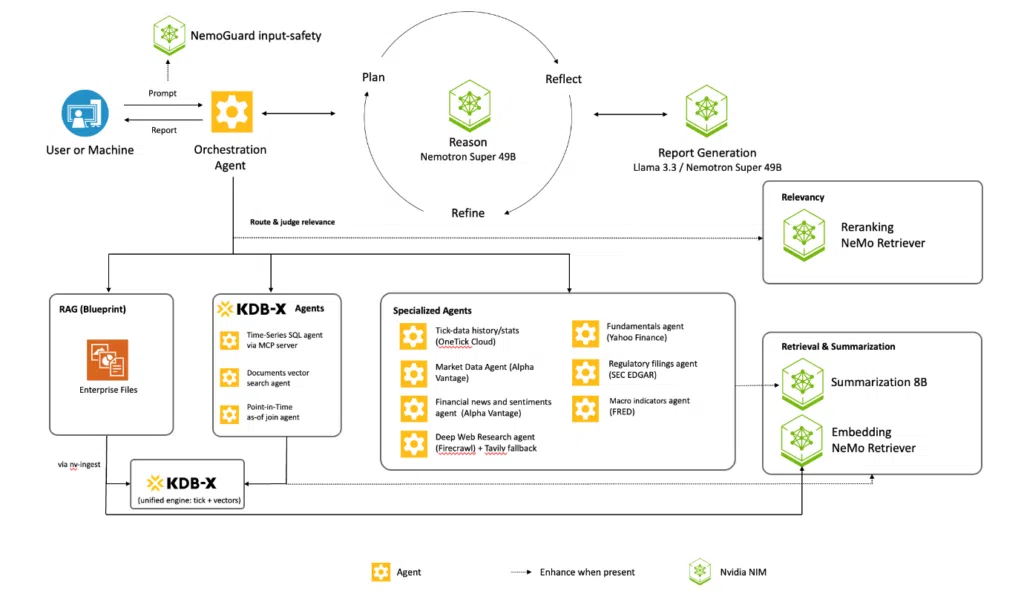
The user of the system selects one or more data sources for the research. Combining multiple sources gives more comprehensive results. Core sources of the system are:
- KDB-X Database: Financial time-series data
- Documents (RAG): Uploaded document collections
- Web Search: The most up-to-date information, via Tavily
Additional source agents appear in the selector once their backend credentials are configured.
Step 1: Input Validation and Orchestration
The workflow starts when a user enters a prompt, e.g. “Research NVIDIA’s AI strategy combining financial data and news articles.”
The prompt can optionally be passed through NVIDIA NeMo Guardrails to perform input safety checks. The request is then handed to the orchestration agent, which coordinates the entire workflow.
This orchestration agent focuses on determining how the question should be answered, rather than immediately generating a response.
Step 2: Planning and reasoning
The orchestration agent invokes a reasoning model (Llama Nemotron Super) to analyze the prompt and create a research plan.
The model decomposes the query into a series of smaller research objectives. For example, the system might determine that it needs to:
- Retrieve recent earnings information from SEC filings
- Examine recent price movements and trading activity
- Analyze news articles and market sentiment
- Review company fundamentals
- Identify any relevant macroeconomic factors
The system then creates a research plan with multiple queries, along with the rationale for why each query matters. The user can add, edit, or remove queries before executing the plan.
Step 3: Execute research plan
The Agent Activity in the user interface shows real-time progress as the system works through the plan. The orchestration agent routes each task to one or more specialized agents. Because each agent operates independently, many of the retrieval tasks can execute in parallel.
For structured financial data, the blueprint uses KDB-X, enabling high-performance time-series analytics over market data. For unstructured content such as research reports, enterprise documents, and SEC filings, NVIDIA NeMo Retriever generates embeddings and performs vector search to identify the most relevant passages.
Step 4: Refining the report
Once the report has been generated, users can use the Q&A interface to ask follow-up questions or rewrite sections with a different focus.
By grounding responses in retrieved data, the blueprint reduces hallucinations and produces responses that are traceable back to their source, with each claim linked to the citations that support it.
Why Does KDB-X Matter for AI-Driven Investment Research?
KDB-X powers the KX Trader Agent Blueprint, enabling AI agents to retrieve, analyze, and reason over financial information. While large language models are built to understand natural language, they are not designed to process vast volumes of live market data or execute complex analytical queries. KDB-X closes this gap by providing fast access to both structured and unstructured data. Its high-performance time-series engine allows agents to query historical market data using familiar SQL syntax, making it possible to analyze price trends, compare performance over time, and investigate market behavior with low latency.
KDB-X also supports point-in-time “as-of” joins, a key capability for financial analysis that combines datasets based on what information was available at a specific moment in time. This ensures historical analysis remains accurate by preventing future information from influencing results. Alongside traditional SQL-like queries, KDB-X provides vector search, enabling semantic retrieval across research reports, enterprise documents, and SEC filings. This means documents are searched based on meaning and context, allowing the most relevant information to be retrieved for a given question.
Together, these capabilities enable the blueprint to perform retrieval-augmented generation (RAG) across both structured and unstructured financial data. Market prices, company fundamentals, macroeconomic indicators, news, SEC filings, and internal research can all be retrieved within a single workflow, providing the language model with trusted evidence to support its responses. For financial AI applications, where investment decisions depend on both quantitative analysis and qualitative insight, KDB-X provides the data foundation that makes the blueprint’s research transparent, accurate, and grounded in real financial information.
Who Is the KX Trader Agent Blueprint For?
This blueprint is designed for a broad range of users across financial services and enterprise IT. Research and financial analysts can use it to query time-series financial data in natural language, analyze market trends, and generate evidence-backed research reports that combine real-time market data with news, regulatory findings, and more.
IT organizations can deploy the blueprint on-premises to provide a secure, enterprise-grade AI research platform that integrates with existing data sources and infrastructure. Developers and solution architects can use the project as a reference for building their own domain-specific AI agent applications, adapting the blueprint to meet the needs of their organization and extending it with additional data sources, tools, or specialized agents.
Conclusion
The KX Trader Agent Blueprint demonstrates how agentic AI can automate parts of financial research by combining the reasoning capabilities of large language models with trusted financial data and high-performance analytics. By orchestrating specialized AI agents, integrating KDB-X for time-series and vector search, and grounding responses in real-world data, the blueprint provides a practical reference architecture for building transparent, evidence-backed research applications.
If you’re interested in deploying the blueprint yourself, the project documentation includes detailed guidance on deployment options, security considerations, software prerequisites and hardware requirements with support for Docker Compose, Kubernetes via Helm, and hosted NVIDIA NIM microservices.
To explore the project in more detail, including the complete source code, documentation, and an interactive demo application, visit the NVIDIA KX Trading Agents repository on GitHub. The repository includes the documentation, source code, and demo application you need to understand the architecture, experiment with the blueprint, and adapt it to your own financial AI applications.