
Key Takeaways
- Fragmented AI data stacks can add latency, cost, operational complexity, and control risk to capital-markets workflows.
- Every data handoff can introduce copies, transformations, inconsistent timestamps, and harder-to-reproduce AI outputs.
- AI delivers greater value when live market data, historical context, and vector retrieval can work together with consistent controls.
- Firms should assess the full path from source data to model output, including every system, transformation, owner, and failure point.
- KDB-X helps reduce critical-path handoffs by bringing streaming, historical, vector, and analytical workloads together in one runtime.
I have spent much of the past 20 years working with banks on data warehouses, analytics, and the infrastructure around them. Recently, I keep hearing versions of the same request: “We want to put AI into production, but we do not want another platform to maintain.”
The response is often to assemble a vector database, feature store, streaming platform, time series database, warehouse, model service, and several pipelines to connect them. Add deadlines and a few older systems that cannot easily be changed, and the AI Frankenstack starts to take shape.

Each component may solve a legitimate problem. Trouble begins when an AI workflow has to cross several of them.
Every handoff introduces something else to measure, reconcile, secure, monitor, and support. In capital markets, it can also separate an AI model from the live and historical market state needed to interpret its output correctly.
AI Adoption Is Exposing Infrastructure Integration Constraints
AI use is now widespread across financial services. The Bank of England and Financial Conduct Authority’s 2026 survey found that 86% of responding firms were using AI.
Adoption alone does not tell us what those systems are delivering. A separate 2026 global study from the Cambridge Centre for Alternative Finance, produced with organizations including the Bank for International Settlements and International Monetary Fund, found that only 14% of surveyed financial-services firms saw AI changing their organizational strategy and competitive advantage. More than half found it difficult to measure the value of AI deployment, rising to 76% among large financial institutions.
Infrastructure is one part of that gap. In the Bank of England and FCA survey, integration into existing business processes was identified as a large constraint by 23% of respondents, with legacy systems or infrastructure close behind at 22%.
Firms are buying and building AI systems. The harder work lies in connecting them to trusted data, existing workflows, and production infrastructure without creating another layer of complexity.
How Data Handoffs Create Latency, Cost, and Control Risk
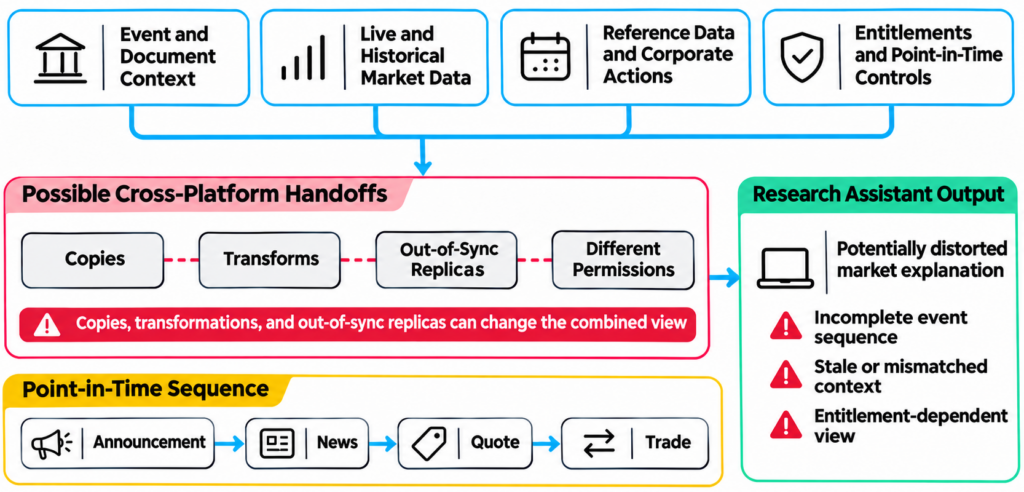
Consider a research assistant trying to answer a seemingly simple question: what changed in the market after a central-bank announcement, and which previous events produced a similar response?
The answer may require the announcement itself, document embeddings, tick history, order-book data, instrument reference data, corporate actions, and the latest market state. It may also need to respect entitlements and distinguish what was known at the time from information corrected later.
When that information lives across several platforms, the workflow can involve multiple data copies, identifiers, timestamps, permissions, and transformation rules. The model may receive data that is individually accurate but inconsistent as a combined view of the event.
Latency is one part of the problem. Data may need to be serialized into another format, copied to a different store, transformed into a new schema, queued for processing, and joined against a replica that updates on another schedule. Each operation may be fast in isolation. The complete workflow can still return an answer based on stale or mismatched information.
For many capital-markets applications, sequence matters as much as response time. A trade, quote, limit change, and news event can all be valid records. Put them in the wrong order and the interpretation changes.
The same issue appears between research and production. A quant may build a model in Python using one historical dataset and one set of feature calculations. Production may then run on another engine, against a different market-data feed, with features recreated by another team.
Small differences can alter the result: timestamp precision, null handling, symbol mapping, corporate-action treatment, or the point at which a feature becomes available. The model may behave differently because production has not recreated the conditions under which it was tested.
Then there is the cost of keeping the connections running.
Integration cost rarely arrives in one large invoice. It accumulates through schema mappings, authentication, error handling, retries, monitoring, upgrades, and recovery procedures across every interface. When one provider changes an API or data model, the effects may travel through several downstream systems.
The old line “buy cheap, buy twice” feels relevant here. In infrastructure, firms may buy the component and then pay again for the engineering required to make it operate as part of a reliable platform.
More interfaces and data copies create more places to reconcile permissions, lineage, versions, and monitoring. That becomes particularly visible when a firm needs to reproduce an important output months after it was generated.
This is how an architecture problem can surface as an AI problem.
Three Questions That Expose the Stack Tax
When I speak with firms about AI architecture, three questions usually reveal more than a long feature comparison.
How many systems does one AI workflow touch, and can you reconstruct the route later?
Trace a representative workflow from the user or model back to the underlying data. Count the systems, copies, transformations, authentication boundaries, and operational owners. Include what happens when one component is unavailable.
Can live market data, historical context, and vector retrieval be combined without repeated copying or ad hoc reconciliation?
Access to each source is only the start. The workflow also needs consistent timestamps, identifiers, entitlements, and point-in-time context. If each request triggers ad hoc extraction and reconciliation across several systems, the architecture adds delay and makes the result harder to reproduce.
How much engineering effort goes into integration rather than the application?
Include pipeline maintenance, schema changes, duplicated monitoring, incident investigation, and the work needed to reproduce results across environments. License cost is only one line in the total.
There is no magic number of systems. A handoff earns its place when it provides a distinct capability, control, or operational benefit that justifies its cost. Others persist because decisions were made at different times by different teams, without the complete path being revisited.
That complete path is where the stack tax becomes visible.
Reducing Critical Path Handoffs With KDB-X
Banks will continue to use data warehouses, lakes, model providers, execution systems, and specialist applications. The practical objective is a shorter, more consistent path between the data and the decision.
That can mean analyzing live and historical data in the same environment, keeping features close to their underlying observations, reducing format conversions, and using the same analytical logic in research and production. Open interfaces and realistic exit plans remain important, because simplification should not create a new concentration problem.
This is where KDB-X has a specific role.
KDB-X provides one runtime for streaming, historical, and vector workloads, with access through q, Python, and SQL. Its AI Libraries support vector, hybrid, fuzzy, and time-series similarity search. KDB-X GPU Acceleration can move supported operations such as joins, aggregations, matrix calculations, and model scoring to NVIDIA GPUs.
This gives firms the option to keep market data, historical context, embeddings, and analytical operations closer together. Research and production teams can work through different languages while sharing the same underlying data model and runtime.
The result can be fewer data copies, fewer transformations, and fewer interfaces to maintain across the latency-sensitive part of the workflow. Keeping more of the analytical path in one runtime also reduces the number of interfaces from which teams must collect the evidence behind a result.
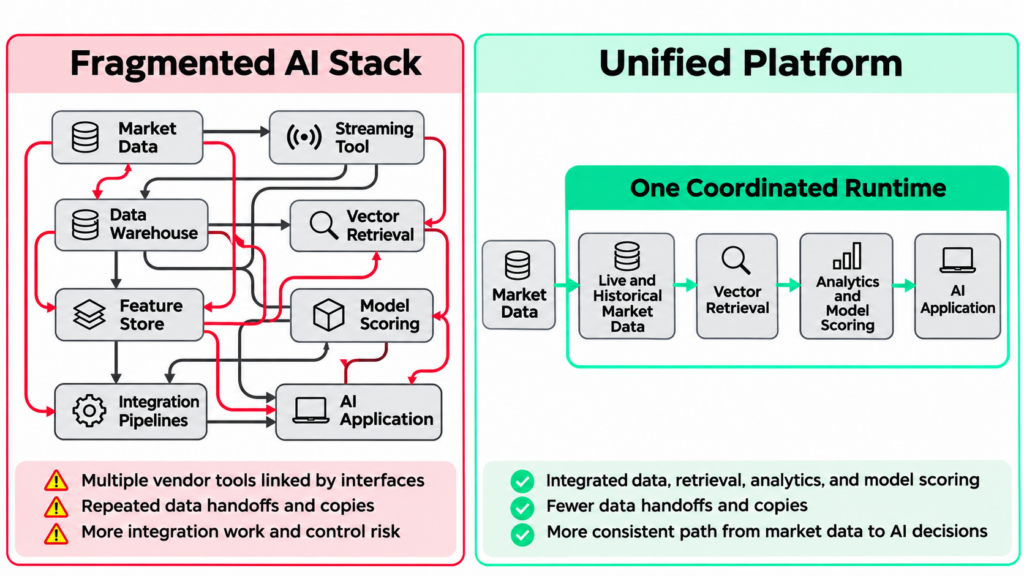
A Frankenstack rarely appears as a deliberate plan. It grows through a series of reasonable decisions: one database for a new data type, one service for a new model, one pipeline to meet a deadline.
Before adding the next component, take an important AI workflow and map its complete route. Record every system it crosses, every copy it uses, every transformation applied, and every team needed to keep it running.
If the route is difficult to explain, it will be even harder to operate at scale.
Every seam should earn its place.
Explore how KDB-X brings time-series, vector, and real-time analytics into one runtime