

Developer
Processing Under Pressure: A Guide to Accelerating Capital Markets Workloads With CPU + GPU Compute

Find out where GPU acceleration can add throughput to compute-heavy capital markets workloads.
Download the ebook to learn how CPU and GPU resources can support the same workflow, how to identify suitable workloads, what can limit performance, and how to benchmark results in your existing q environment.
ポイント
- Agentic AI in capital markets must complete its reasoning loop before the underlying market state changes.
- Latency compounds across retrieval, analysis, validation, and action, making system-level speed a core constraint.
- The right time budget depends on the workflow, from hours for research to milliseconds for latency-sensitive execution.
- Temporal context helps agents reason against the correct market state and supports later audit, review, and improvement.
- Firms need to measure how efficiently models, data, compute, and infrastructure turn into correct decisions within the available time window.
I started my career in control systems. The first lesson you learn there is that a controller with lag does not simply get slower. It becomes unstable, because it is acting on a state that has already changed.
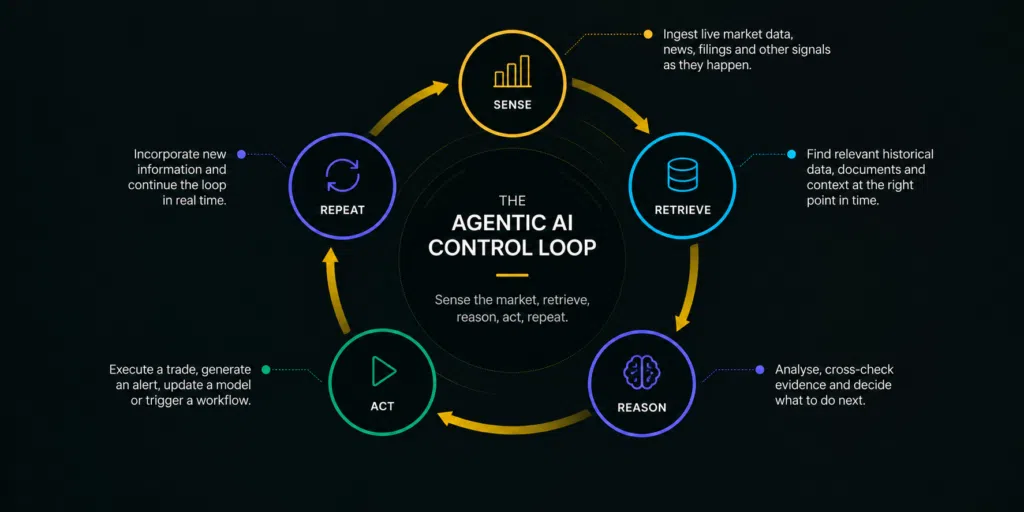
Agentic AI in capital markets is a control loop: sense the market, retrieve, reason, act, repeat. While the loop runs, prices move, liquidity disappears, signals decay, and new information can overturn the logic of a decision in seconds. Speed is no longer the edge. It is the ante, the price of getting into the game at all.
The best model in the room still loses if the infrastructure beneath it cannot keep pace. A competitor whose agent answers sooner may already have acted while yours is still working through the evidence.
What Is Fast Enough?
Most firms still judge AI performance at the model level, but an agent does not ask one question. It plans, retrieves, calculates, checks what it finds, decides what to do next, and repeats. Much of that is sequential, because the next question depends on the previous answer, so a few seconds of latency on one query becomes tens of seconds across a reasoning loop, before inference, network calls, and tool execution are counted. Agentic AI turns latency from a query-level metric into a system-level constraint.
There is no single definition of fast enough. The time budget depends on the workflow:
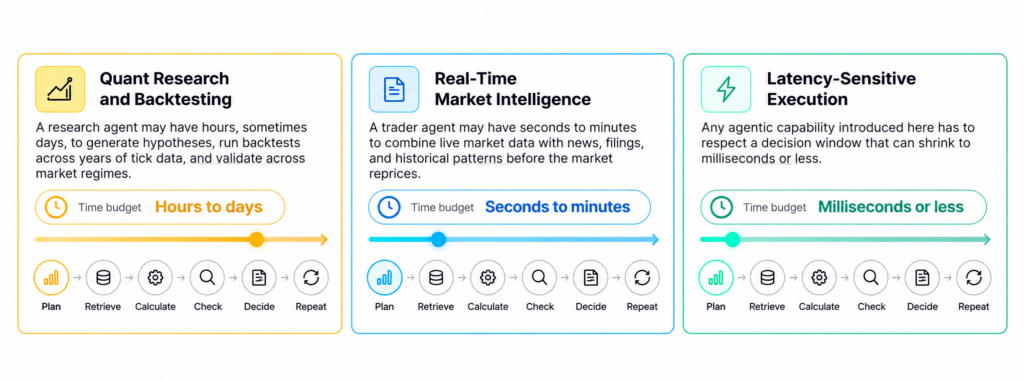
- Quant Research and Backtesting: A research agent may have hours, sometimes days, to generate hypotheses, run backtests across years of tick data, and validate across market regimes. Faster compute expands how much research fits inside that window.
- Real-Time Market Intelligence: A trader agent may have seconds or minutes to combine live market data with news, filings, and historical patterns before the market reprices. Every delay cuts the time left to cross-check the answer.
- Latency-Sensitive Execution: Any agentic capability introduced here has to respect a decision window that can shrink to milliseconds or less.
The budgets differ. The requirement does not: complete enough useful reasoning inside the window, or pay for intelligence you cannot use. The production agents I have seen succeed at banks and hedge funds share one property. The loop closes fast enough that the answer is still true when it arrives.
Slow AI Is Expensive AI
At sub-second query speeds, an agent feels like another analyst on the desk. At tens of seconds, you have paid for an empty chair.
Recent testing by a major financial institution, in its own AWS environment, makes the scale tangible. Standard queries averaged 75 milliseconds on KDB-X on CPU against 22.2 seconds on the incumbent system: across a simple loop of ten dependent queries, under a second of database wait time against 3 minutes 42 seconds. On complex queries, where parallel work dominates, KDB-X with GPU acceleration averaged 201 milliseconds against 31.9 seconds, roughly two seconds against more than five minutes over the same ten-query loop.
At capital markets scale, that gap decides how many investigations, validations, and decisions a firm completes with the AI capacity it has already paid for. The metric I would put in front of every board is cost per correct decision: how efficiently the spend on models, data, compute, and infrastructure becomes decisions the firm can actually use.
Speed Needs Temporal Truth
Speed is necessary, not sufficient. You cannot control what you cannot observe, and an agent reasoning over a stale picture of market state will act quickly and confidently on the wrong thing.
Capital markets data is inherently temporal. A trade belongs to a particular order book. A risk signal can be valid in one regime and irrelevant in the next. An agent needs to know what was true, when it was true, what the system knew at the time, and what changed afterwards. Cross into unstructured data and it gets harder: news, filings, and historical patterns have to be aligned to the same market state, or the agent reasons confidently from the wrong era.
This is why temporal AI infrastructure is fundamental. Event-time ordering, as-of joins, point-in-time reconstruction, and bi-temporal integrity keep the sequence and validity of information intact through the whole loop. It also answers a question every firm will face once agents are in production: if you cannot reconstruct what an agent knew at the moment it acted, you cannot audit it, improve it, or trust it.
Fewer Seams, Deliberate Compute
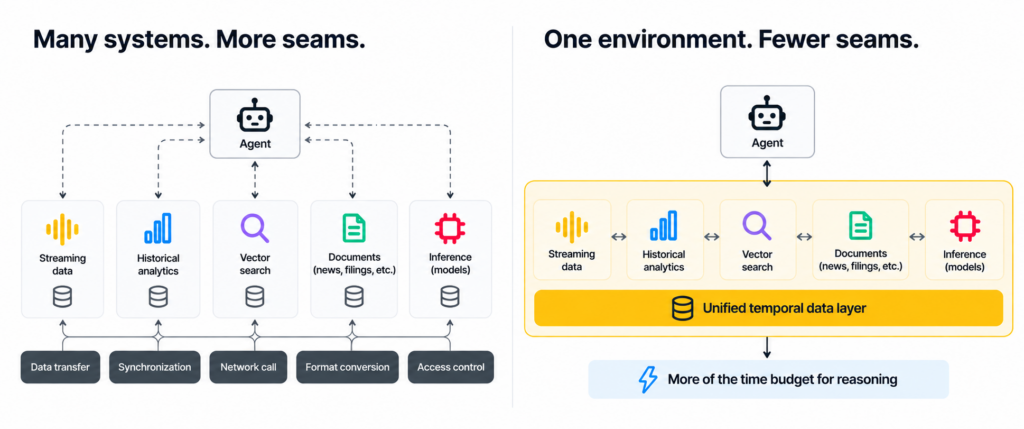
Many capital markets stacks split streaming data, historical analytics, vector search, documents, and inference across separate systems. An agent can touch all of them in one task, and every boundary adds a transfer, a synchronization point, or a network call. Bringing time-series analytics and vector retrieval into one environment lets an agent move from an unusual tick pattern straight to the relevant filings, or replay the exact market state around a surveillance alert, without shipping data between systems. Fewer seams leave more of the time budget for reasoning.
Compute deserves the same discipline, and here I disagree with much of the current spending. Most firms are buying GPUs for models and starving the data layer that feeds them. CPUs remain the right tool for ingestion, orchestration, control logic, and much of the analytics. GPUs earn their place where large, repeated, parallel workloads dominate: large scans, complex joins and aggregations, Monte Carlo analysis. Aim GPU power at the specific bottlenecks that stop an agent finishing inside its time budget, and you buy another backtest, a deeper scenario analysis, or one more validation cycle before the answer loses its value.
It’s About Time
KX has spent three decades on exactly the characteristics of capital markets data that agentic AI now depends on: speed, scale, and temporal context. KDB-X brings streaming and historical analytics, time-series and vector data, temporal replay, and accelerated compute into one environment. Our partnership with NVIDIA extends that into the AI compute layer, from GPU acceleration to NIM microservices and cuVS vector search, so firms can combine model reasoning, semantic retrieval, and deterministic temporal analytics at capital markets scale.
The reason to care is not the machine. It is the people on the desk. Every second an agent spends waiting on its data is a second a trader, an analyst, or a compliance officer spends waiting on the agent. Make the loop fast and the data true, and people get their time back for the judgment calls only they can make.
Speed alone is no longer the edge; it’s the ante that gets agentic AI into the game. Temporal intelligence is what lets you win the hand. See why the world’s leading firms rely on KX’s temporal AI infrastructure to turn raw data into trusted decisions at the pace of modern markets.
Processing Under Pressure: A Guide to Accelerating Capital Markets Workloads With CPU + GPU Compute
Find out where GPU acceleration can add throughput to compute-heavy capital markets workloads.
Download the ebook to learn how CPU and GPU resources can support the same workflow, how to identify suitable workloads, what can limit performance, and how to benchmark results in your existing q environment.