

kdb+
kdb+ is the world’s fastest, high-performance time-series database and analytics engine, powered by the vector language q. For over 30 years, it has delivered ultra-low latency access to real-time and historical data across Capital Markets, Defense, and High-Tech Manufacturing.
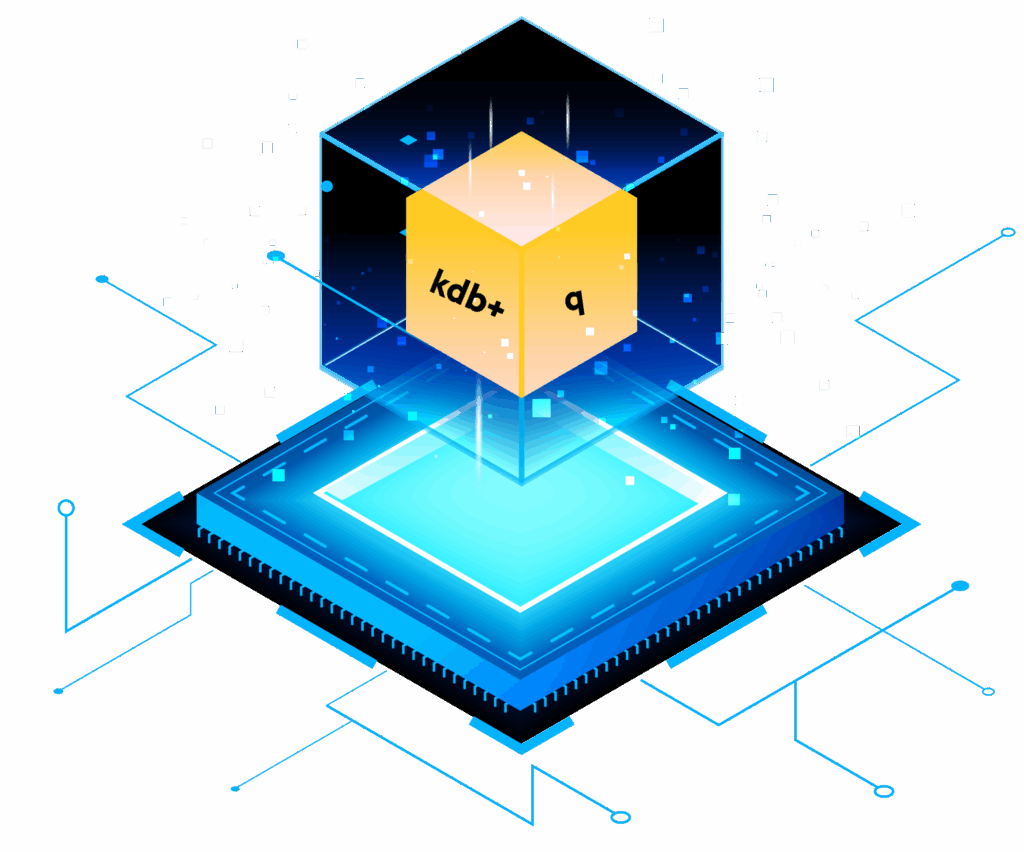
kdb+ runs directly on the CPU for the fastest possible execution.
From Passion To Powering The Planet’s Most Critical Data
kdb+ is the world’s fastest time-series database and analytics engine, built to capture, analyze, and act on data in motion. Created by computer scientist Arthur Whitney, a pioneer in high-performance programming languages, it began as a passion project in pursuit of speed and simplicity.
Today, kdb+ powers the world’s most data-intensive systems, from global financial markets to aerospace and advanced manufacturing. Combining Whitney’s elegant q language with a robust in-memory architecture, kdb+ enables organizations to process massive volumes of streaming and historical data in real time, all within a single, unified environment.
The Art of Compute Efficiency
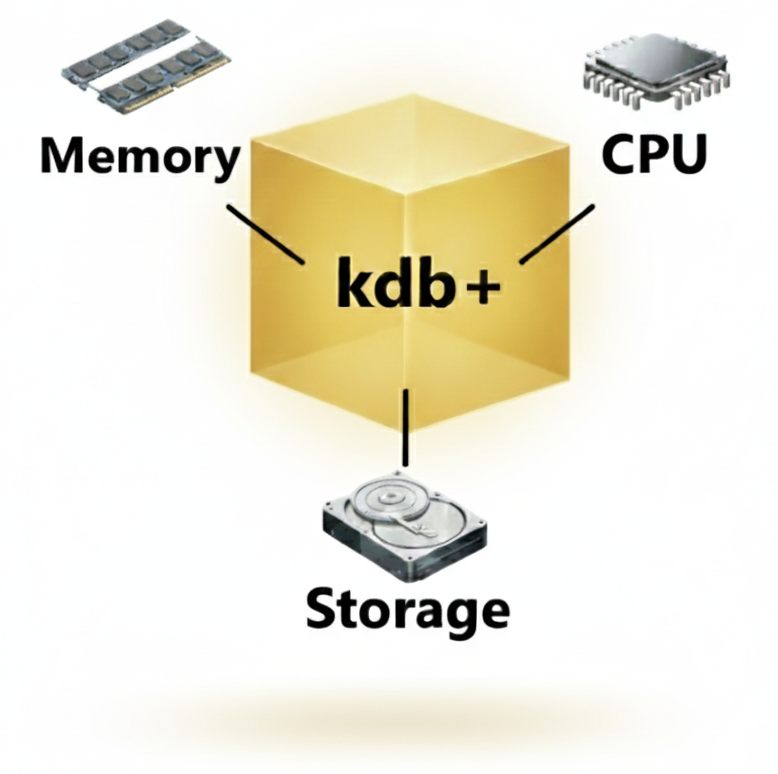
kdb+’s benchmark-leading performance is the result of its thoughtfully engineered development. It leverages the CPU, memory, and storage to work in perfect harmony.
The Software – The entire system is less than 1 MB and fits directly in the CPU’s cache, meaning instructions don’t have to wait to load, unlike on other platforms with heavier stacks like Postgres or Java. With no additional layers introducing abstraction, you get the fastest possible execution for any query.
The Language – kdb+ has its own unique language, q, specifically built for kdb+. It is lean by design and delivers a smaller, faster interaction with kdb+ data than C, Python, or SQL. As an array-based language, q treats datasets as vectors rather than individual rows, enabling quick scans across billions of records with no latency between thought and computation.
The Orchestration – Data stored in kdb+ is columnar and time-series by nature, so only the relevant columns are read for the selected time slices, dramatically reducing I/O and processing time. With a unified language and engine specifically built to handle time-series data, unnecessary layers across your data analytics are eliminated.
Everything about kdb+’s design, from its language to its architecture, is built for efficiency, simplicity, and raw performance.
Core Advantages of kdb+
Cache-Aware Execution
Small memory footprint and L1/L2 locality minimize data movement for ultra-low latency.
Multiple languages
Supports our native language q, as well as Python, Java, C#, C++, Rust, R, and open-source libraries.
Time-Series Native
Built-in functions and temporal datatypes (incl. nanosecond timestamps) simplify time-based analytics.
High Performance at Scale
Columnar, in-memory, and parallel execution deliver low-latency analytics on massive data.
Real-Time & Historical
Process streaming and stored data together for rapid, informed decisions.
Cost-Efficient
Lower TCO with storage/compute optimized for time-series and high-throughput workloads.
In-Memory Processing for Sub-Millisecond Insight
kdb+ ingests and analyzes real-time data directly in memory, removing disk latency and accelerating time to insight. By working entirely in RAM, it delivers sub-millisecond performance for time-critical workloads such as trading, fraud detection, and IoT monitoring. Live data is instantly available for analysis, enabling users to query and act on information as it arrives.
Intelligent storage keeps performance high & costs low
- As data moves from memory to disk, kdb+ automatically shifts it between storage tiers without affecting access or speed.
- This seamless data lifecycle keeps hot data in RAM and colder data on disk, balancing low-latency performance with long-term scalability.
- The result is consistent query speed and optimized infrastructure costs, even at the petabyte scale.
Tiered databases deliver speed and scalability
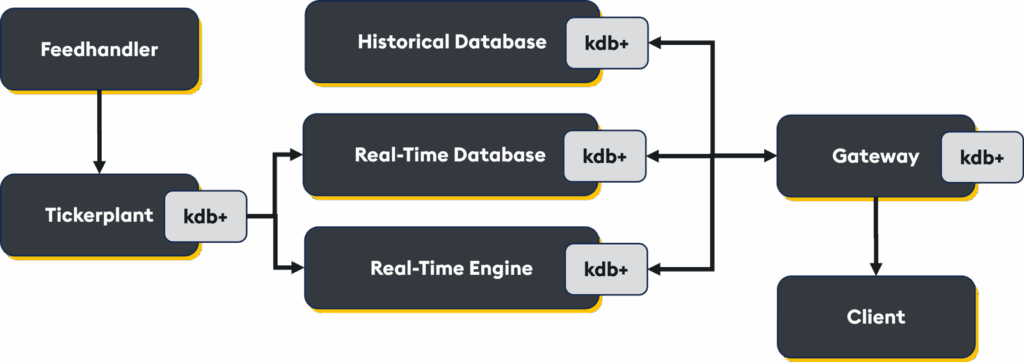
- The Real-Time Database (RDB) holds the newest, high-frequency data in memory for sub-millisecond queries.
- The Intraday Database (IDB) stores recent data on disk in small time partitions for efficient access and minimal memory pressure.
- The Historical Database (HDB) archives long-term data in a columnar format for backtesting, compliance, and analytics at scale.
Memory mapping eliminates I/O bottlenecks
- kdb+ maps disk files directly into memory, eliminating the need for costly read/write operations and data translation.
- This architecture allows the CPU to access stored data as if it were already in RAM, dramatically cutting I/O overhead.
- Combined with in-database compute, queries run at near-memory speed across all tiers, delivering real-time results to the client.
Built for the most demanding environments, kdb+ holds 15 of 17 STAC-M3* world records.
98%
Fastest query times across audited STAC-M3 tests
36%
Lower latency under 100-user workloads
1.6 PiB
Tested storage — over 6× larger than prior record
19/24
Record-breaking results in STAC-M3 Kanaga meant time response benchmarks
*“STAC” and all STAC names are trademarks or registered trademarks of the Securities Technology Analysis Center, LLC.”
kdb+ Powered Products
KDB-X
A unified stack for Time Series, Vector Data, and AI Workloads:
- Natively query Parquet and kdb+ data together with q, Python, and SQL in one environment
- Speed up compute-heavy operaitons with GPU Acceleration (Spring ’26).
- Build AI Solutions AI Libraries for better search and link to popular LLMs with MCP Server
kdb Insights
Cloud-native and on-premises analytics platform
KX Delta
Real-time data streaming for the defense industry
KX Sensors
Large-Volume streaming for IoT and OEM industry
KDB.AI
Vector database designed for analytics and AI
kdb+’s q Language Delivers Speed
The q language transforms kdb+ from a traditional database into a high-performance compute engine. Built for speed, precision, and simplicity, q combines vectorized execution, functional design, and temporal intelligence to deliver real-time insight from massive datasets.
Vector processing eliminates looping inefficiencies
- Traditional databases process data row by row, which slows performance as datasets grow.
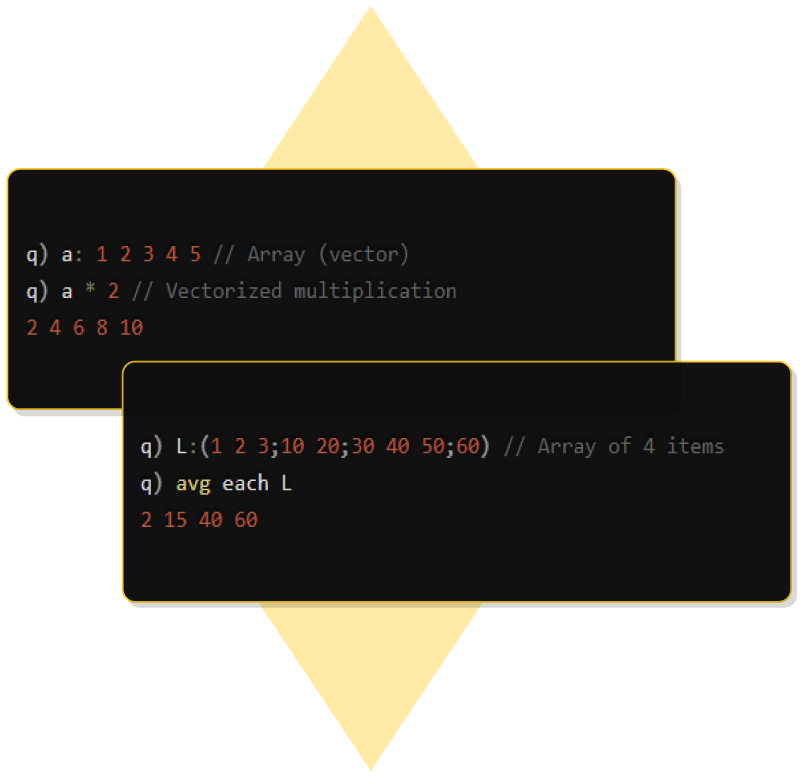
- q uses vectorized execution, applying operations to entire arrays at once via SIMD (Single Instruction, Multiple Data).
- This reduces the need for explicit loops and lets the CPU process millions of data points simultaneously.
Vectorized processing lets q handle massive datasets in memory with minimal overhead.


Ready to get hands on?
Get certified in kdb+
Our courses, aimed at beginners and experienced developers, cover the practical usage of kdb+.
KX Academy
Advance your kdb+ learning journey with free, interactive, on-demand training.
KX Community
Connect with experts and get to grips with our world-leading real-time data analytics technology.
Demo the world’s fastest database for vector, time-series, and real-time analytics
Start your journey to becoming an AI-first enterprise with 100x* more performant data and MLOps pipelines.
- Process data at unmatched speed and scale
- Build high-performance data-driven applications
- Turbocharge analytics tools in the cloud, on premise, or at the edge
*Based on time-series queries running in real-world use cases on customer environments.
Book a demo with an expert
"*" indicates required fields