

Key Takeaways
- Temporal AI gives capital markets firms a time-accurate record of what data, models, and controls were in place when an AI decision was made.
- Bi-temporal data helps prevent AI from using information that was correct at the wrong point in time.
- Temporal traceability makes AI-generated trading, risk, and compliance decisions easier to audit, explain, and defend.
- A temporal flight recorder links data, model versions, policies, actions, and outcomes into one governed historical record.
- Firms with Temporal AI Infrastructure can deploy AI into higher-consequence capital markets workflows with greater confidence.
In the film Sully, a passenger jet loses both engines over New York. Later computer simulations suggest Flight 1549 could have turned back and landed safely. But this hindsight view missed a vital factor: human reaction time. When the simulations account for what the pilots could have known, and when they could act, the result changes dramatically.
Today, capital markets firms need the same clear temporal view into AI decision-making: an unchangeable record that can reconstruct the exact state of the world at any historical moment, including what was known and unknown when an action was taken.
That’s easier said than done. The volume, variety, and velocity of data are soaring. Trades span more venues, jurisdictions, and instruments. And agentic AI will operate at unprecedented speed and scale, accelerating research, generating signals, and supporting increasingly complex trading, risk, and compliance workflows.
Firms also face tightening regulation, and simply demonstrating surveillance coverage is no longer enough. MAR, MiFID II RTS 6, SR 26-2, Canada’s E-23 guideline, effective 2027, and the EU AI Act all point towards closer scrutiny of controls, model governance, and traceability.
For capital markets leaders deploying AI for trading, risk, and compliance, the urgent question is whether they can trust its output, because a decision that can’t be opened can’t be defended. Compliance will increasingly demand both high-quality data and the temporal traceability to connect that data to every consequential AI-generated insight, signal, and recommendation.
Capital Markets AI Needs a Temporal Flight Recorder
Before AI can inform decisions reliably, it needs the temporal precision to locate itself in market reality. This starts with Temporal AI Infrastructure that ensures systems can understand, preserve, and reason over time.
Firms must record two dimensions of time: when a fact was true in the market and when the system received or changed it. As I argued in my blog on temporal hallucination, AI can produce a plausible answer that may once have been correct yet belongs to the wrong era. Bi-temporal integrity helps prevent this failure mode by preserving what was true, what the system knew, and when each fact entered or changed inside the system.
However, the importance of temporal precision extends beyond accurate AI decisions. It also plays a vital role in ensuring they’re defensible. The same Temporal AI Infrastructure foundation provides a permanent record of how and when data passed through models, rules, controls, and tools to produce an output that informed a decision.
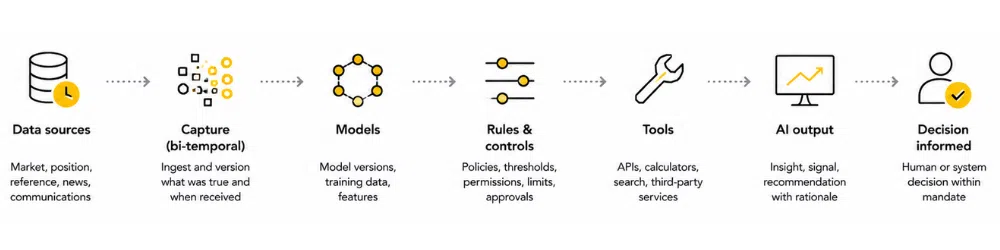
This ensures that every AI-generated insight, signal, or recommendation is traceable to the exact sequence of data, context, controls, and decision logic that produced it.
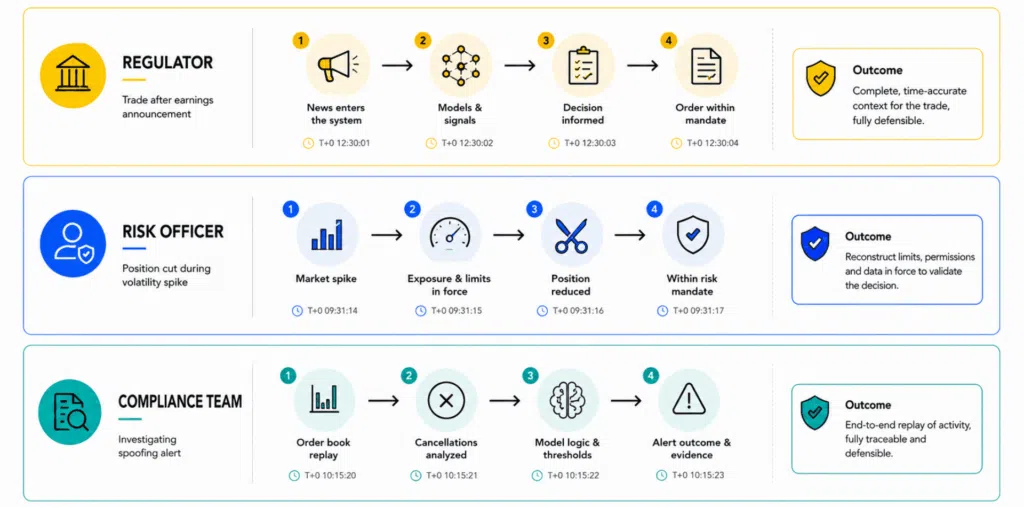
A regulator reviewing a trade placed seconds after an earnings announcement should be able to see when the news entered the system, which models and signals informed the decision, and whether the order stayed within mandate. A risk officer reviewing a position cut during a volatility spike should be able to reconstruct the exposure data, limits, permissions, and thresholds in force. A compliance team investigating a spoofing alert should be able to replay the order book, cancellations, executions, model logic, and active thresholds.
Trust Must Scale with Consequence
As AI becomes more deeply embedded in capital markets workflows, the importance of understanding how its outputs were produced increases. Whether AI is supporting research, generating signals, surfacing anomalies, or informing risk and compliance teams, firms need to be able to reconstruct the data, context and controls behind every consequential output.
A research assistant working from stale data may produce a misleading conclusion. A signal-generation model operating against an incomplete market state may surface the wrong opportunity. And a surveillance system using outdated thresholds may fail to identify activity that warrants investigation. Human oversight remains critical, but effective oversight depends on people being able to understand and verify the evidence on which AI-generated outputs are based.
With an infrastructure foundation that treats time as the organizing principle of the entire system, firms can put AI into more consequential workflows, sooner. Teams can act with confidence by testing agents against historical market states, comparing behavior across model versions, validating controls before deployment, and investigating unexpected actions without rebuilding evidence by hand.
In contrast, without temporal traceability, valuable AI use cases may remain trapped in pilots because compliance teams can’t approve them with confidence.
Mind the Governance Gap
A regulatory review can take place months or years after an agent acted. By then, source data may have been corrected, models retrained, thresholds recalibrated, and permissions changed. The live system may bear little resemblance to the one that made the original decision. SR 26-2 highlights the governance challenge: generative and agentic AI sit outside the scope of the revised model risk management guidance, with firms expected to rely on appropriate internal risk-management and governance practices for technologies not covered by it. That makes preserving the evidence behind AI-informed decisions all the more important.
To close this gap, the market record, model registry, policy engine, agent logs, and approval history must remain linked through a single governed temporal record. Separate systems may each hold accurate information while still failing to reproduce the sequence, versions, and controls that shaped the agent’s output.
As such, a financial flight recorder must preserve one linked chain from data to outcome. That chain begins at capture, where temporal integrity must be established and then preserved throughout the decision lifecycle.
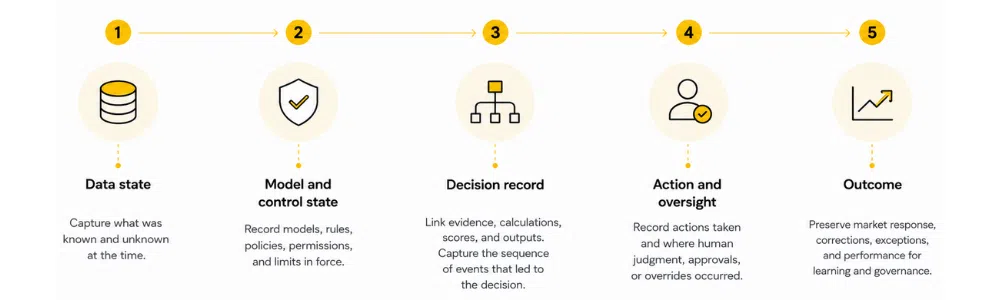
Data State
Captures the market, position, document, and communications data available at the time. It preserves timestamps, versions, corrections, and the boundary between known and unknown information.
Model and Control State
Records the model version, rules, thresholds, policies, permissions, tools, and risk limits then in force, along with their testing, approval, and change history.
Decision Record
Links the evidence retrieved, calculations performed, scores generated, and outputs produced. For an agentic workflow, it also captures the sequence of events connecting the initial instruction to the final decision.
Action and Oversight
Records the trade, hedge, risk adjustment, escalation, approval, override, or workflow change that followed the AI-generated output. It shows where human judgment entered, what decision was ultimately taken, and whether it stayed within authorized boundaries.
Outcome
Preserves the market response, later corrections, exceptions, performance, and subsequent review. This supports learning and model governance while keeping the original decision state intact.
Together, these records give regulators, risk officers, boards, model validators, and engineers a shared view of the same historical event.
Defensible Decisions Are an Edge in the Market
Strategic advantage will increasingly be locked into the infrastructure layer beneath AI applications. But temporal traceability must be built in, not bolted on to the data platform.
KX is built to capture, sequence, and replay every event at nanosecond precision, providing the immutable temporal record that makes AI decisions defensible.
KDB-X provides the temporal compute engine for capital markets AI: capturing, sequencing, replaying, reasoning, and auditing at production speed. OneTick Market Data strengthens the record by normalizing data across venues while preserving temporal metadata. OneTick Surveillance applies the same principle to compliance through time-aligned evidence, transparent detection logic, order-book replay, model-change history, approval workflows, and integrated case records.
Trust the Decision from Inside the Moment
In Sully, the pilots’ decisions were put under a microscope: not just what they knew, but when.
As AI becomes more deeply embedded in research, trading, risk, and compliance workflows, capital markets firms need their own version of a flight recorder to trust the temporal foundation beneath every decision. A firm that controls clean, accurate, bi-temporal data has a structural advantage that no model fine-tuning can replicate.
See why the world’s leading firms with more than $50 trillion in assets under management rely on KX’s Temporal AI Infrastructure to turn raw data into trusted and defensible decisions at the speed and scale of modern markets.