

Key Takeaways
- AI in capital markets needs temporal precision to understand not just what happened, but when it happened and what was knowable at the time.
- Without point-in-time context, AI systems can produce plausible but misleading answers based on data from the wrong market moment.
- Market data is sequential, so trustworthy AI must preserve the order, timing, and causality of trades, quotes, orders, filings, and events.
- Temporal AI Infrastructure helps firms capture, sequence, replay, reason over, and audit market data for more defensible AI decisions.
- KDB-X and OneTick Market Data provide a temporal foundation for AI by grounding decisions in accurate, sequenced, and auditable market data.
As AI becomes embedded in trading, research, and investment workflows, attention is shifting from models alone to the data infrastructure that supports them. In capital markets, where timing defines truth, temporal precision is becoming a foundational requirement for trustworthy AI.
What do agentic AI systems in capital markets have in common with 18th-century sailing ships?
More than you might think.
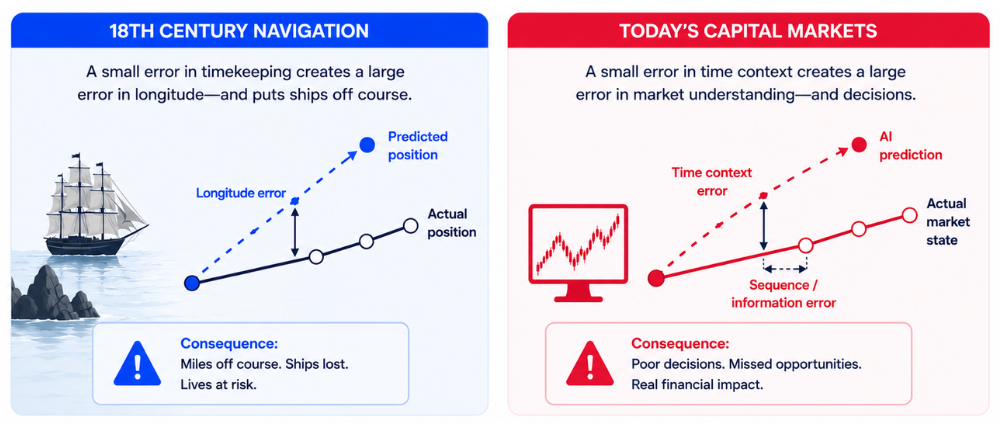
In 1707, Admiral Sir Cloudesley Shovell’s fleet struck rocks off the Isles of Scilly after fatally miscalculating its position. Four Royal Navy ships were lost, and more than 1,400 sailors died. The disaster became one of history’s most famous navigational failures.
It is remembered as a longitude failure: the challenge of fixing a ship’s east-west position at sea. While sailors could calculate latitude using the sun and stars, determining longitude required something far more difficult: keeping incredibly accurate time. A ship needed a clock that could preserve the exact time at a fixed reference point, such as Greenwich, despite months of rolling seas, temperature changes, humidity, and vibration.
The margin for error was astonishingly small. A clock drifting by just one minute could place a ship more than 17 miles from its true position, enough to turn safe navigation into disaster.
Today, capital markets face their own longitude problem.
As AI evolves from an advisory tool into an autonomous decision-maker, firms may feel confident about where they are. But without an understanding of temporal context, they’re navigating fast-moving markets without a reliable way to know exactly where they stand or how close they are to the rocks.
Why AI needs to understand market sequence, not just snapshots of market data
Firms today have more data than ever. Every tick, trade, quote, order, execution, filing, transcript, research note, client message, and news event can be captured, stored, searched, and analyzed. AI can process more of this information, faster, than any human team. But generic AI has no native sense of time. Without temporal context, it can’t reliably locate itself in market reality.
A price isn’t just a price. It’s a price at a specific point in the order book, against a specific spread, after certain orders arrived and before others were canceled.
A trade isn’t just an execution. It’s the result of a sequence of quotes, routes, decisions, venue conditions, and liquidity states.
A filing isn’t just a document. It has a publication time, an ingestion time, a version history, and a window in which it was actionable.
For AI, understanding timing, sequence, and causality is the difference between learning the market and learning a distorted reconstruction of it. An AI system needs to know when something happened in the market, when it entered the system, whether a later correction changed it, and what else was knowable at that point.
Without that ability, backtests face look-ahead bias, retrieval can surface facts from the wrong era, and agents can act on signals whose half-life has already expired. As I discussed in my last piece, this is where temporal hallucination begins: not because a model lacks information, but because it lacks temporal precision.
The longitude problem was eventually solved by a clockmaker. John Harrison built a marine chronometer that held true time through months of rolling seas, and once a ship could keep accurate time, its position became calculable. Capital markets need the same thing: an engine that keeps true time through rapidly changing conditions, so that market state becomes calculable rather than guessed. That depends on infrastructure that can capture, timestamp, and sequence every event in order, with full fidelity, at the speed the market actually moves.
Time must be the organizing principle of capital markets AI infrastructure
Many data platforms treat time as an attribute: a field added to a row, or a column near the margin. They can sort by time, query by time, and attach time to records. But that’s not the same as preserving temporal integrity.
Capital markets AI needs infrastructure that treats time as the organizing principle. It must capture, sequence, replay, reason over, and audit every event in its correct temporal context.
This is Temporal AI Infrastructure, the layer that ensures AI decisions are grounded in when data was true, not just what it says.
A timestamp can tell you when a record was written. It doesn’t necessarily tell you when the fact was true in the world, when the system learned it, whether it was later amended, or which version was available to a model at the moment of decision.
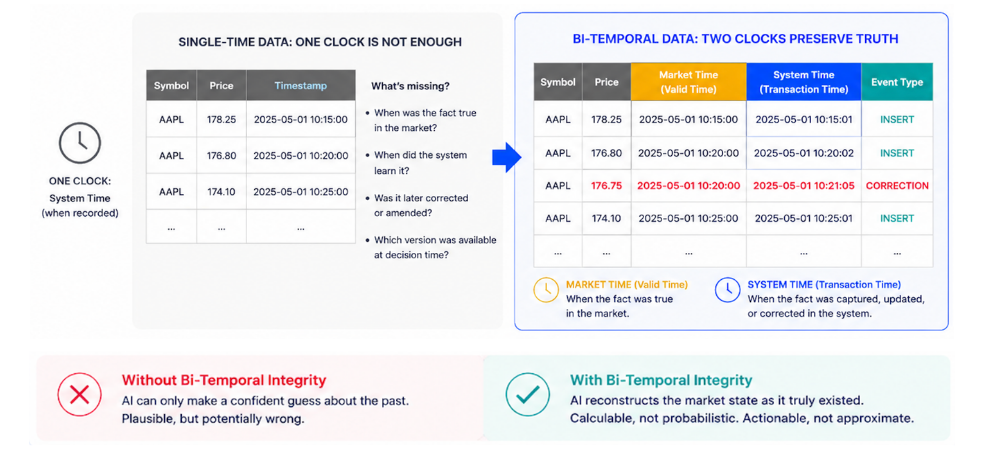
To achieve that, firms need bi-temporal integrity at the infrastructure layer. This gives AI two clocks to reason from: the moment a fact applied in the market and the moment that fact entered or changed inside the system. If either clock is missing, the model cannot distinguish the market state that existed at decision time from the record as it appears later.
Most AI in markets is probabilistic: it produces a confident guess about what happened.
Temporal AI makes market state at any moment calculable: not an estimate of the past, but a faithful reconstruction of it. Calculable, not probabilistic, is the line between a model that sounds right and a system you can act on.
The KX temporal trust stack: Five layers of temporal AI infrastructure
For AI to act in capital markets, trust has to begin at the moment data enters the system, when market reality is first captured and ordered.
At KX, we think about this as the temporal trust stack, a five-layer framework to preserve temporal integrity across the full data lifecycle.
 1. Capture
 1. Capture
Capture preserves market events exactly as they occurred, before meaning is lost through transformation or aggregation. This begins with high-fidelity market data. OneTick Market Data captures and normalizes data across venues, preserves exchange timestamps and temporal metadata, and delivers a consistent, point-in-time view of market events. KDB-X then ingests both streaming and historical data with native temporal datatypes and nanosecond precision, creating a trusted foundation for trading, risk, compliance, and AI workloads.
2. Sequence
Sequence keeps events in the order that gives them meaning: orders before trades, quotes before fills, cancellations before liquidity disappears, news before repricing. This is where temporal operations such as as-of joins, window functions, and time-aligned correlations become foundational rather than technical conveniences.
3. Replay
Replay lets teams deterministically reconstruct the market as it was known at the time. Given the same inputs, it returns the same state every time, not the version that was later cleaned, corrected, or reinterpreted.
4. Reason
Reason aligns market data and language to precise event time, so AI can move beyond correlation toward context. Capital markets intelligence lives across structured and unstructured data: ticks, trades, quotes, orders, filings, news, transcripts, research, chats, and client interactions. Temporal reasoning connects those worlds without stripping away the order, freshness, and validity that give them meaning.
5. Audit
Audit closes the loop. If an AI-assisted decision cannot be traced back to the data state that informed it, it cannot be defended. The question is no longer just “what did the model answer?” It is “what did the system know when the answer was produced, and can we prove it?” Proof requires deterministic reconstruction, not a best guess after the fact.
This is how temporal integrity becomes trust. Not through a better prompt, a smarter model, or a faster dashboard, but through infrastructure that preserves the temporal structure of the market end to end.
KX enables this at the infrastructure level. KDB-X provides the temporal compute engine for capital markets AI: capturing, sequencing, replaying, reasoning, and auditing at production speed. OneTick Market Data strengthens that foundation by normalizing market data across venues with temporal metadata preserved, so downstream AI workflows start from data that is clean, sequenced, and defensible.
Together, they give firms a single temporal foundation from which to build, test, deploy, and defend AI in live market environments.
Navigate markets with temporal precision
Every firm will be able to retrieve, summarize, classify, fine-tune, and automate with commoditized AI models. The durable advantage will come from the temporal data foundation beneath them.
The firms that win will have the most accurate navigation system for the market: data that is structured, sequenced, replayable, and faithful to when facts were true. A model without that structure can never truly understand market reality. The data is the algorithm.
Harrison’s chronometer did not predict the sea. It kept true time so sailors could know exactly where they were. KX does the same for markets: we keep true time across every event at nanosecond precision, so market state is calculable and every AI decision built on it is defensible. For 30 years, we have helped the world’s most demanding financial institutions do exactly that, at the speed capital markets run.
Intelligence without time is like navigation without longitude. See why the world’s leading firms with more than $50 trillion in assets under management rely on KX’s temporal AI infrastructure to turn raw data into trusted decisions at the speed of modern markets.