
Key Takeaways
- AI audit debt builds when firms deploy AI without preserving the evidence behind its decisions.
- In capital markets, accurate replay depends on knowing what data, model, controls and market context were available at the time.
- A plausible explanation generated later cannot prove why an AI system acted when it did.
- As AI agents gain more autonomy, firms need stronger traceability across data, models, actions and human oversight.
- Temporal infrastructure helps firms capture, sequence and replay decisions so they can be validated, explained and defended.
I came up as a control systems engineer, where you log state because you know you’ll be asked to explain a fault later. Observability and traceability need to be built in, not bolted on. Retrofitting them into a live system is almost always harder and more expensive.
That’s something every firm building out AI needs to keep front of mind today, because audit debt is fast becoming the new technical debt.
Technical debt is a trade-off: save time or money now but pay more later because you underinvested in the foundations. In capital markets AI, this same false economy can appear when a prototype works, the answers look good, and the business wants to go live now.
Under pressure to move faster, teams focus on the visible layer: the model, the application, and the user experience. They defer the vital data foundation underneath. Point-in-time state, lineage, and replay become problems for later. But months down the line, when risk teams, regulators, or a client ask, ‘Why did you do this?’, there’s no good answer.
Audit debt is cheap to create and expensive to repay. Indeed, repayment is sometimes impossible because the precise historical state behind the original decision was never preserved. It also raises the cost of every AI decision by demanding layers of manual review, remediation, and revalidation.
That’s a critical issue when trust is such a fundamental gatekeeper for AI adoption. A system may be fast, useful, and economical. Yet the more authority we give it, the more important one question becomes: Can we prove why this decision was made, based on what was knowable at the time?
If the answer is no, trust becomes the limit on AI autonomy.
Audit Debt Compounds With Complexity
Audit debt can begin with sensible choices. Early AI workflows are easy to inspect. A proof of concept may use one model, a few data sources, and a team that checks every answer.
Then the workflow grows. Models evolve. Market data is corrected. Retrieval reaches into more sources. Permissions and risk limits are altered. Every change creates a new state that may matter later when trying to show why a decision or action was taken. Each layer makes the original decision path harder to recover.
Take a research agent backtesting a strategy. If the historical data has since been cleaned, restated, or adjusted for events that were not yet known, can the firm prove the agent only saw the information available at the time? If not, the backtest may quietly benefit from hindsight.
Equally, a surveillance alert might depend on the exact order in which bids, cancellations, and executions hit several venues, together with the alert logic then in force. Change that sequence or apply today’s thresholds and you’re investigating a different event.
The longer firms wait to preserve these states, the harder it becomes to reconstruct what the system actually knew and did.
This is where the false economy becomes visible. The very shortcut that got AI into production faster can become the thing that stops it moving forward at pace.
Plausibility Isn’t Proof
With deterministic systems, preserving the code, inputs, and state gives us a clear path to reproduce an outcome. But generative AI is probabilistic.
Ask the same model the same question twice and the answer may differ. Come back six months later and even more may have changed: the model, prompt, retrieved documents, vector index, tool configuration, permissions, controls, and underlying data.
The system can still produce an excellent explanation of what it would do now. That doesn’t prove what it did then. If a trader agent routed an order to Venue A because Venue B’s displayed liquidity had disappeared, an explanation generated later from corrected or consolidated data may look perfectly plausible while describing a market state the agent never saw.
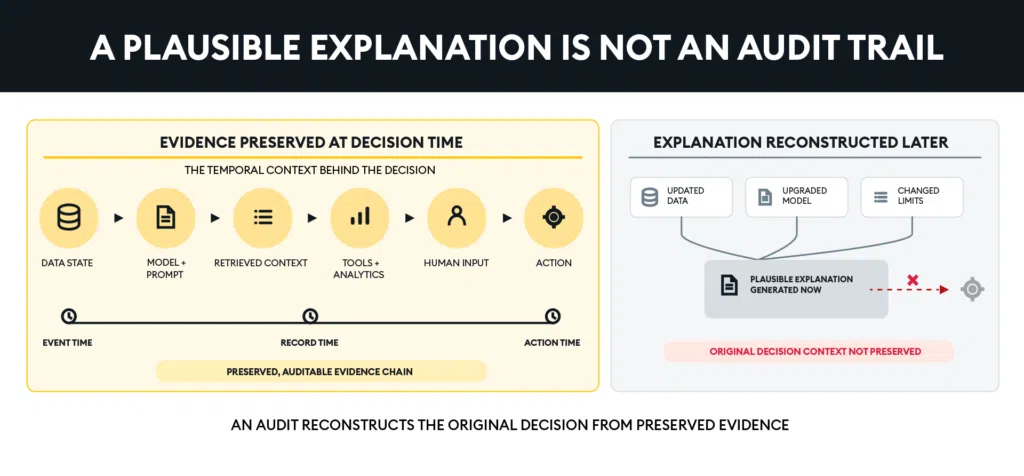
That’s where explanation and reconstruction part company. An audit requires evidence.
Your model can be probabilistic, but the data layer underneath it must be deterministic. Otherwise replay is theater.
For a consequential decision, firms need to preserve the chain that shaped it: the data available at that point, the model and prompt in force, the context retrieved, the tools called, the analytics applied, any human intervention, and the action that followed.
Temporal context is central to that evidence. Generative AI learns patterns from language and data; it has no native sense of time. An AI decision can span three different clocks: when something happened, when the system learned or recorded it, and when a person or agent acted. Losing the relationship between those moments can make it impossible to audit the decision.
Imagine an agent recommends reducing a position after an earnings release. The filing is corrected the next morning. Six months later, today’s database contains the corrected number, the model has been upgraded, and the firm’s risk limits have changed. Risk doesn’t need to know what the current agent would recommend; it needs to know which filing, market state, limits, and model informed the original action.
If you only preserve the latest market state, you can reconstruct what you know now. You can’t reliably reconstruct what the system knew then. That’s why firms must have data that stores the full temporal sequence and makes point-in-time truth replayable.
Trust Demands Traceability
The adoption of agentic AI that uses probabilistic models to decide how to pursue a goal only makes this challenge more urgent.
Trust in increasingly autonomous systems doesn’t require perfection; humans make mistakes too. But it does require traceability: what the agent knew, which data and model it used, what action followed and why.
Capital markets already understand this discipline. When a regulator investigates a trade, firms don’t rebuild the market from today’s cleaned-up data and ask what probably happened. They preserve order histories, timestamps, and event timelines because sequence is evidence. Agentic AI extends that discipline from market events into reasoning and action.
Beware the argument that auditability can wait until the system’s working. If you can’t explain a consequential decision, the system isn’t production-ready.
At KX, we think about temporal trust as a chain: Capture → Sequence → Replay → Reason → Audit.
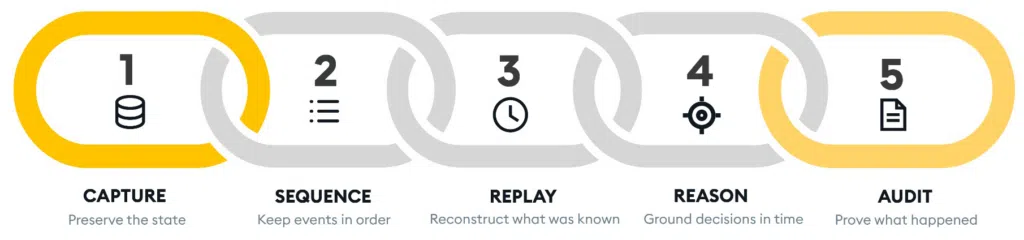
Capture the state faithfully. Preserve the sequence that gives events meaning. Keep that history replayable. Ground reasoning in the right point in time. Then an audit can reconstruct the decision from evidence.
As AI autonomy rises, the evidence chain has to strengthen with it. A research copilot that produces a weak summary has limited authority. An agent that proposes a hedge has more. An agent that can change a position, alter exposure, or trigger another workflow more still.
Firms will only widen that autonomy if they can test, trace, and replay what the system does.
Cost Per Correct Decision
We think about production AI in terms of cost per correct decision: the total cost of compute, data, infrastructure, and models per decision the firm can validate and act on with confidence.
A system can look cheap per query and still be expensive per decision the business is willing to trust.
Audit debt pushes that cost up. Risk adds manual checks. Compliance requires new controls. Engineering builds replay and logging around systems that were never designed for them. Model validation slows because teams can’t compare versions against the same historical state.
Infrastructure debt can often be cleared with an upgrade or rip-and-replace. Lost historical state is different. If you never captured the data, model, and decision context, you can’t buy them back later.
KDB-X provides the time-aware data layer for this evidence path, preserving event sequence and point-in-time market state for replay. Model registries, policies, agent logs, and approvals complete the wider audit record. OneTick Trade and Market Surveillance applies the same discipline to alerts, market context, and case history.
To assess where you stand today, ask: What did an agent see? Which model, controls, and limits were in force? Can we replay the decision exactly as it happened? If your teams can’t answer those questions, your firm may already be carrying AI audit debt.
The evidence required for an audit has to be captured from the start, even when the investigation itself comes much later. Explore how KX’s Temporal AI Infrastructure is providing the foundation for trusted AI decisions in capital markets.